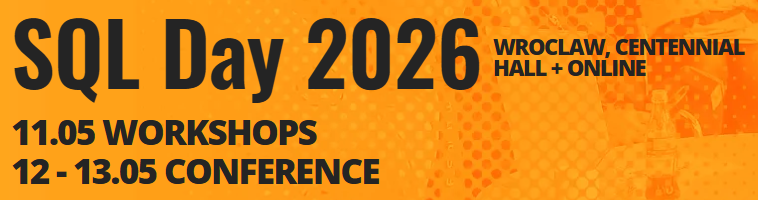
SQLDay 2026 offers a full-day workshop program on 11 May 2026, before the main conference scheduled for 12–13 May 2026 in Wrocław, with onsite and online participation options depending on the session. The workshops cover several areas of the modern data platform: advanced BI, AI and MLOps, SQL performance tuning, PostgreSQL adoption, and Microsoft Fabric automation.
DAX – Beyond the Basics
This workshop is designed for Power BI users who already know the basics of DAX but now need to solve more complex business problems. The focus is on moving from simple reports to reusable, efficient and business-oriented DAX patterns.
Participants will work on practical scenarios such as advanced slicer logic, hierarchical calculations, year-to-date reporting, visual calculations, cumulative totals, ranking, and relative-period analysis. The main objective is to extend the participant’s DAX toolbox and help them write expressions that are both more powerful and better performing
AI in Databricks: Training, Deployment and Monitoring
This Polish onsite workshop covers the complete lifecycle of machine learning models in Databricks. The goal is to show how to move from data preparation to training, automation, deployment and monitoring in a production-oriented environment.
The workshop focuses on the practical implementation of MLOps using Databricks and MLflow. Topics include AI/ML architecture, data pipelines, feature engineering, model training, deep learning, CI/CD, orchestration, model versioning and monitoring. It is mainly targeted at engineers, data scientists and architects who are already working with machine learning or planning to start.
Building an Intelligent Agent in One Day with Copilot Studio
This Polish onsite workshop focuses on building conversational and autonomous agents with Microsoft Copilot Studio. The format is highly practical, with most of the time dedicated to hands-on exercises.
Participants will build agents that automate business processes, use multimodal data, generate data-driven answers and connect to enterprise data sources. The workshop also covers Dataverse grounding, flows, plugins, actions, autonomous triggers, Responsible AI, moderation and access control. It is a good fit for participants who want to understand how Copilot Studio can be used beyond simple chatbot scenarios.
Advanced T-SQL Triage: The Art of Fixing Terrible Code
This workshop is focused on real-world SQL Server troubleshooting and refactoring. The starting point is familiar to many DBAs and developers: complex stored procedures, poor query patterns, blocking data modifications, bad use of CTEs, problematic window functions, indexed views, dynamic SQL, user-defined functions and execution plans that are difficult to understand.
The objective is not only to identify what is slow, but also to understand why it is slow and how to rewrite it properly. This session is especially relevant for people who regularly inherit problematic T-SQL code and need a structured way to fix it without guessing.
Adding PostgreSQL to your SQL Server Skill Set
This workshop targets SQL Server professionals who need to add PostgreSQL to their technical scope. The context is clear: many organizations are adding PostgreSQL without immediately replacing SQL Server, which creates a need for people who understand both platforms.
The workshop compares the two database engines, explains the areas of overlap, and highlights the differences that can make PostgreSQL challenging for SQL Server users. It also covers tooling, documentation, cloud options and practical resources to support the learning path.
Automating Your Microsoft Fabric Data Platform: From Blueprint to Reality
This onsite hands-on lab focuses on automation in Microsoft Fabric. The goal is to help participants automate the full lifecycle of a Fabric data platform, from design and setup to deployment and documentation.
The workshop covers platform setup using code and configuration scripts, metadata-driven ingestion, semantic model foundations, CI/CD with GitHub and Azure DevOps, Fabric CLI, REST APIs and the fabric-cicd Python library. The expected outcome is a more robust, scalable and repeatable approach to building Fabric solutions, with less manual work and lower operational risk.
Conclusion
The SQLDay 2026 workshop program is clearly oriented toward practical implementation. Each session addresses a common challenge faced by data teams: improving analytical models, industrializing AI, fixing complex SQL code, extending SQL Server skills to PostgreSQL, or automating a modern Microsoft Fabric platform.
The common thread is operational efficiency. These workshops are not only about learning features; they are about applying them in real environments, with constraints such as performance, maintainability, automation, governance and production readiness.
Thank you. Amine Haloui.
References :
![Thumbnail [60x60]](https://www.dbi-services.com/blog/wp-content/uploads/2024/03/AHI_web.jpg)
![Thumbnail [90x90]](https://www.dbi-services.com/blog/wp-content/uploads/2025/11/LTO_WEB.jpg)
![Thumbnail [90x90]](https://www.dbi-services.com/blog/wp-content/uploads/2022/08/ADE_WEB-min-scaled.jpg)