Skip to content

High Availability

SQL Server 2016 : availability groups and load balancing features

Let’s continue with this third post about SQL Server AlwaysOn and availability groups. Others studies are available here: New database issue level detection for automatic failover Potential features in standard edition Automatic failover enhancements This time I’ll talk about read-only secondaries and the new load-balancing support that will be introduced by SQL Server 2016. First of all, SQL Server 2014… 

SQL Server 2016 : availability groups and automatic failover enhancements

Let’s continue with this study of the new availability group enhancements. Others studies are available here: New database issue level detection for automatic failover Potential features in standard edition This time we’ll talk about the possibility to enrol a third replica for automatic failover. It implies of course to configure synchronous replication between the 2 pairs of replicas and this… 

Weird issue with sys.fn_hadr_backup_is_preferred_replica() function

A couple of days ago, I faced a weird backup issue with SQL Server AlwaysOn and availability groups at one of my customer (thank to him to point out this issue 🙂 ). After installing our DMK tool (Database Management Kit) about database maintenance for AlwaysOn, my customer noticed that their databases have not backed up. Ouch … what’s going… 

Windows Cluster vNext and cloud witness

The next version of Windows will provide some interesting features about WFSC architectures. One of them is the new quorum type: “Node majority and cloud witness” which will solve many cases where a third datacenter is mandatory and missing to achieve a truly resilient quorum. Let’s imagine the following scenario that may concern the implementation of either an SQL Server… 

12c: shutdown abort a PDB?

By Franck Pachot . Can we shutdown abort a PDB? Let’s try: SQL> show con_id CON_ID —————————— 3SQL> shutdown abort; Pluggable Database closed. But is it really a shutdown abort? The shutdown abort we know in non-CDB – or in a CDB from CDB$ROOT – is used when the instance cannot checkpoint before closing the file. It leaves the files… 

Is CDB stable after one patchset and two PSU?

By Franck Pachot . There has been the announce that non-CDB is deprecated, and the reaction that CDB is not yet stable. Well. Let’s talk about the major issue I’ve encountered. Multitenant is there for consolidation. What is the major requirement of consolidation? It’s availability. If you put all your databases into one server and managed by one instance, then… 

SQL Server 2014: FCIs, availability groups, and TCP port conflict issues

After giving my session about SQL Server AlwaysOn and availability groups at the last French event “Les journées SQL Server 2014”, I had several questions concerning the port conflict issues, particularly the differences that exist between FCIs and availability groups (AAGs) on this subject. In fact, in both cases, we may have port conflicts depending on which components that are… 

SQL Server: Forced failover with AlwaysOn & Availability Groups

During a workshop at one of my customer about the implementation of SQL Server AlwaysOn and availability groups, I had an interesting discussion. It was about asynchronous replication between 2 replicas and the effect of the forced failover operation with allowed data loss. Does SQL Server resynchronize availability databases if I loose some transactions during the failover process? The quick… 

High availability in the Oracle landscape

It’s now several weeks I attended some event about high availability (HA). But what is actually high availability? According to our friend Wikipedia, HA is based on 3 main principals: Elimination of Single Point of Failure (SPoF) Reliable crossover (with minimal or no downtime) Detection of failures when they arrive If those principals are met, end users may never realize… 

MySQL high availability management with ClusterControl

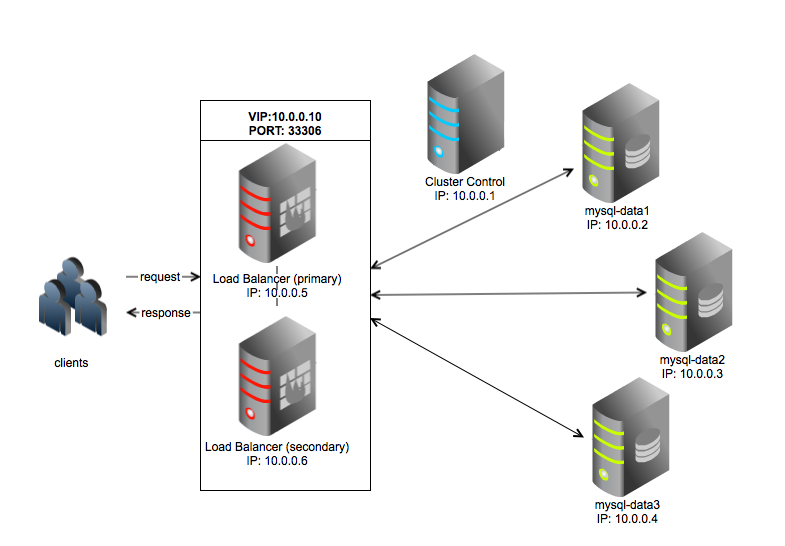
Installing and managing a highly available MySQL infrastructure can be really tedious. Solutions to facilitate database and system administrator’s task exist, but few of these cover the complete database lifecycle and address all the database infrastructure management requirements. Severalnines’ product ClusterControl is probably the only solution that covers the full infrastructure lifecycle and is also able to provide a full…