Skip to content

direct seeding

SQL Server 2016: distributed availability groups and cascaded replicas

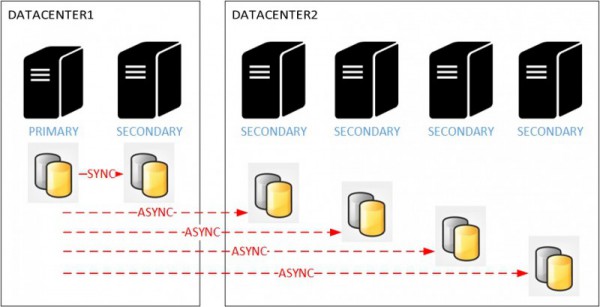
During the last MVP summit, we had some interesting discussions about availability groups with the SQL Server team and I remember someone asked for managing scenarios like Oracle cascaded destinations and the good news is that SQL Server 2016 already addresses this kind of scenario with distributed availability groups. For example, let’s say you have to manage heavily reporting activity… 
SQL Server 2016: Distributed availability groups and Cross Cluster migration

How to migrate an environment that includes availability groups from one Windows Failover Cluster to another one? This scenario is definitely uncommon and requires a good preparation. How to achieve this task depends mainly of your context. Indeed, we may use a plenty of scenarios according to the architecture in-place as well as the customer constraints in terms of maximum… 

SQL Server 2016 AlwaysOn: Direct seeding and backup considerations

As promised in my prior blog post, we’ll talk now about direct seeding feature and backups. We found an interesting LIMIT_CONCURRENT_BACKUPS value for current state of the hadr_automatic_seeding_state_transition event. As said last time, this value is meaningful by itself. So let’s try to perform a backup while the database is concerned by an active seeding session. In fact, my backup… 

SQL Server 2016 AlwaysOn: Direct seeding and performance considerations

This blog post follows the previous one about new direct seeding feature shipped with SQL Server 2016. As a reminder, I had some doubts about using direct seeding with large databases because log stream is not compressed by default but I forgot the performance improvements described into the Microsoft BOL. I also remembered to talk about it a couple of months… 

SQL Server 2016 AlwaysOn: Add DBs in AGs with direct seeding

In this blog I would like to talk about two new features shipped with SQL Server 2016 for AlwaysOn availability groups. The first one concerns the new direct seeding capability and the seconde one introduces distributed availability groups (DAG). I will talk about the second one in a next blog post. First of all, let’s talk about direct seeding.  At the first…