Skip to content

Partitioning

Import order matters for GoldenGate instantiation filtering

When migrating a large database with GoldenGate, most of the volume is sometimes in old partitions which no longer change. A common shortcut is to move them first with expdp/impdp, even before GoldenGate is set up. Everything else, the active partitions and the non-partitioned tables, is exported once the extract is running, with PREPARECSN set. Instantiation filtering then makes the… 

Customer case study – Partition switching and transactional replication

The client’s environment includes two SQL Server instances (I1 and I2). One of the databases, D1 (on I1), is replicated to I2 via transactional replication. Additionally, the tables in this database are partitioned. The largest table (which is the one of interest) is approximately 350 GB in size and contains around 800 million rows. This table represents transactions. The client… 

Customer case study – SQL Server table partitioning

A client submitted the following issues : During an audit of their environment, we also noticed that the database data files were hosted on a volume using an MBR partition type (which is limited to 2 TB). 2 tables were involved (but only one needed to be partitioned, the “Data” table) because we had a foreign key constraint between the… 

SQL Server database design – Moving table to new filegroups

Introduction A database is very often created without thinking of its growing and in the most cases that is not really an issue until the data volume is not increasing a lot. And most of the time when a high data volume is expected, some actions are taken to organize the database in a more complex way, creating several data… 

Oracle 12cR2 : Partitioning improvements – online conversion of a non-partitioned table to a partitioned table

It’s time to a new blog about partitioning improvement in 12cR2. After auto-list partitioning and multi-column list partitioning & read-only partitions, I’ll demonstrate how we can easily convert a non-partitioned table to a partitioned table…online ! As a reminder, the way to convert a table to a partitioned table were to use the DBMS_REDEFINITION package (since 9i to 12cR1) which… 

Oracle 12cR2 : Partitioning improvements – multi-column list partitioning & read-only partitions

In my last blog post I presented auto-list partitioning, a new partitioning functionality coming with 12cR2. In this one I will introduce two others : multi-column list partitioning and read-only partitions. Multi-column list partitioning Image : “Oracle Partitioning in Oracle Database 12c Release 2” – Hermann Bär With the first release of 12c it wasn’t possible to create list partitioned… 

Oracle 12cR2 : Partitioning improvements – auto-list partitioning

The second release of Oracle Database 12c (12cR2) comes with new improvements regarding partitioning. In this blog post I’ll show one of them : auto-list partitioning. Auto-list partitioning is an extension of list partitioning. It enable the automatic creation of partitions for new values inserted into the partitioned table. Image : “Oracle Partitioning in Oracle Database 12c Release 2” –… 

Partitioning – When data movement is not performed as expected

This blog is about an interesting partitioning story and curious data movements during merge operation. I was at my one of my customer uses intensively partitioning for various reasons including archiving and manageability. A couple of days ago, we decided to test the new fresh developed script, which will carry out the automatic archiving stuff against the concerned database in… 

SQL Server 2016: TRUNCATE PARTITIONS with sliding Windows scenarios

Some time ago, I had to deal with a new partitioning scenario that included sliding windows stuff for mainly archiving purpose. Regarding the customer context, I used some management scripts that include this time dropping oldest partition. We didn’t care about data oldest than 2 years. Usually in this case, I use a method that consists in dropping data by switching… 

SQL Server: switch partition and metadata inconsistency issue

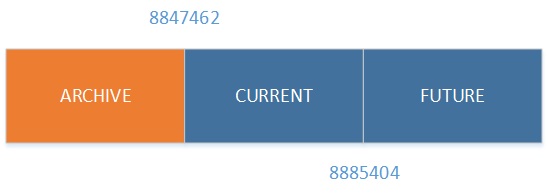
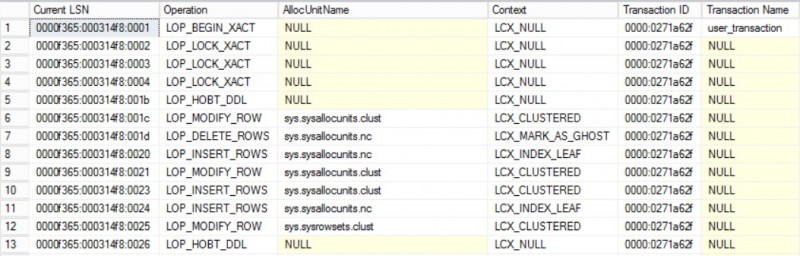
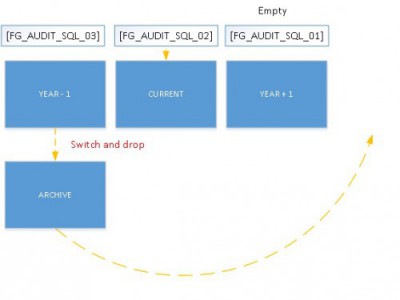
In this blog post, I would like to share with you a weird issue I faced when I implemented a sliding Windows partition scenario on SQL Server 2014 SP1 at one of my customer. The idea was to keep SQL Server audit records from several SQL Server instances into a global archiving table during two years in order to meet… 

Changing an existing partition configuration … Well, not so easy!

This time let’s talk about an interesting customer scenario where table partitioning was implemented on a table with 100 GB of data on SQL Server 2014. Partitioning in this context aimed to save disk space  (archive data were compressed) , help to reduce maintenance time and consumed resources as well (by using index and statistic maintenance operations on the active partition).  Finally,… 

Oracle 12c: Partitioning enhancements Part II – Other improvements

Oracle Database 12c offers several enhancements for partitioning. In a previous blog posting, I talked about reference partitioning enhancements. This post will present other enhancements in relation to general partitioning. Asynchronous index maintenance With Oracle database, a global index becomes UNUSABLE when dropping or truncating the partition on which this index points, until the clause UPDATE GLOBAL INDEXES is used.…