Skip to content

Linux/UNIX

Linux: how to monitor the nofile limit

By Franck Pachot . In a previous post I explained how to measure the number of processes that are generated when a fork() or clone() call checks the nproc limit. There is another limit in /etc/limits.conf – or in /etc/limits.d – that is displayed by ‘ulimit -n’. It’s the number of open files – ‘nofile’ – and here again we… 

Linux: how to monitor the nproc limit

By Franck Pachot . You probably know about ‘nproc’ limits in Linux which are set in /etc/limits.conf and checked with ‘ulimit -u’. But do you know how to handle the monitoring and be alerted when you’re close the fixed limit? Nproc and ps Nproc is defined at OS level to limit the number of processes per user. Oracle 11.2.0.4 documentation… 

How to install and manage a Kerberos Server

For some time now, I have been working on how to set up a Single Sign-On (SSO) solution in my company. As a big fan of Open Source solutions, I have obviously proposed the implementation of a solution based on Kerberos. What I mean by that is a solution based on the true Kerberos, i. e. MIT Kerberos. Indeed, Kerberos… 

Boot sequence for all Linux-based operating systems

In this bog posting, I will present a boot sequence that works for all Linux-based operating systems – from switching on the power to the login screen.   7 steps There are 7 steps for Linux startup: Power on Obviously, first of all, you have to switch on your computer, then: Each sub process will execute the following one It… 

Overview of Oracle Linux releases and kernels

As everybody knows, Linux regroups several operating system families. The most popular Linux OS are Debian, Red Hat, or Suse. But each family has many derived Linux distributions. In November 2006, Oracle released the first version of its operating system, totally based on Red Hat Enterprise Linux: Enterprise Linux. Up to release 5, the system came with two kernels: A… 

Oracle Automatic Memory Management: real memory usage!

When using Automatic Memory Management for Oracle, it is sometimes difficult to monitor the memory usage and in particular to find the right tools to get the right information about currently allocated structures. The instance which will be analyzed has been configured with AMM (Automatic Memory Management) on Oracle Enterprise Linux 6.1. The current memory_target is set to 1 GB:… 

Unable to resize tmpfs on Oracle Enterprise Linux 6 versions

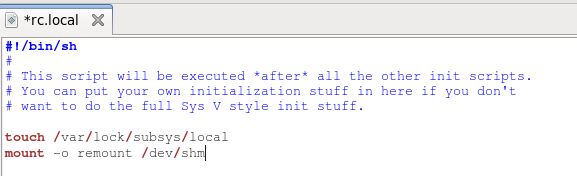
I recently helped to create a lab dedicated to a training about Oracle backup and recovery, with Oracle 11g databases. While creating several databases on an Oracle Enterprise Linux 6.1, I wanted to resize the tmpfs to allocate more memory to the databases for AMM (Automatic Memory Management). That was a small challenge 🙂 … By default, the value of… 

Linux: Disks diagnostic using smartctl

Facing disk issues such as corruption or block defect is thankfully not happening frequently. However when it does, the diagnose may look sometimes like a real struggle. This is forgetting that disks integrate since years the S.M.A.R.T technology. Good point, it can easily be adressed in Linux command line through smartctl What is S.M.A.R.T. exactly? S.M.A.R.T., which stands for Self-Monitoring,… 

hpacucli: Storage management on HP servers through command line

For sure you already used, or at least heard about, the HP Smartstart Kit. This especially includes the storage management part ACU: Array Configuration Utility. This tool is pretty straightforward to configure the storage and RAID volumes before installing an HP server.

However did you know that these features are also available in command line? This is what hpacucli does…