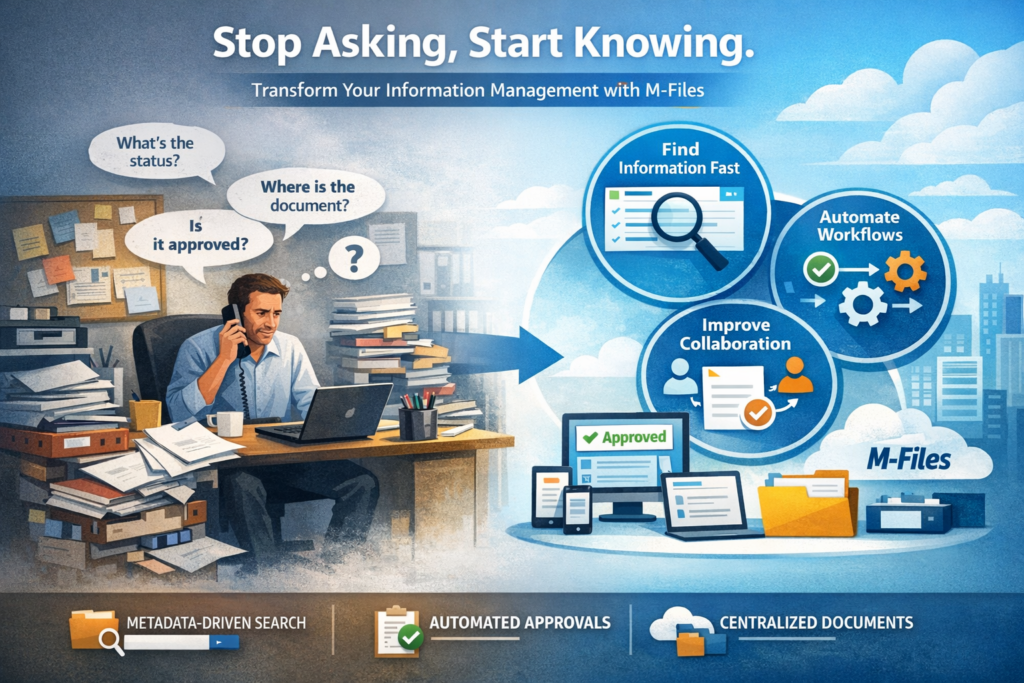
If your team keeps asking: “What’s the status of that project?” “Where is this document?” “Is it approved?”
You don’t have a people problem, you have an information problem!
No one likes to ask their colleagues these questions, and answering them is also tedious because it interrupts the flow of work.
Repetitive questions are a symptom of deeper issues, such as scattered content, unclear ownership, manual approvals, and limited visibility.
The good news? With the right structure and toolset, you can fix this. In this post, I’ll show you practical ways to quickly retrieve information, improve your company’s structure, and demonstrate how M-Files can transform the way your team works. Let’s turn your team into real knowledge workers!
How to Retrieve the Info (Without Hunting)
Fast retrieval isn’t about better folders, it’s about metadata. The question isn’t “Which drive is it on?” but “What is it?”
Search by What, not Where
With metadata-driven search, you don’t care which system the document is stored in. You search by:
Object type: Contract, invoice, SOP, specification, project.
Context: Customer, project code, supplier, product line.
Lifecycle state: Draft, In Review, Approved, Obsolete.
Dates and ownership: Created by, due date, last modified.
A user asks, “Is the contract with Acme approved?” one search filtered by Customer = Acme and State = Approved gives the answer immediately.
Dynamic Views for Role-Based Answers
Instead of browsing folders, create views that answer common questions:
“My Items Needing Action” (everything awaiting your approval or update).
“Projects: In Review” (filter on lifecycle = In Review).
“Contracts Expiring in 90 Days” (date-based rules for proactive renewals).
“Invoices Pending Approval” (status-driven queues for finance).
Views are dynamic: as metadata changes, the view updates automatically. No manual curation, no broken links!
One Truth with Versioning and Audit Trails
When you open a document, you see the single current version plus its history. You don’t need to ask, “Is this the latest?” the system enforces it. Audit trails provide who changed what, when, and why, answering questions before they’re asked.
Improve Company Structure (Without a Reorg)
Information flows are more important than org charts when it comes to structure.
Define ownership: Every document or object (e.g., a project, contract, supplier) has a responsible role.
Standardize lifecycles: Draft ? In Review ? Approved ? Effective ? Obsolete. Clear transitions, clear responsibilities.
Normalize metadata: Master lists for customers, projects, products, and cost centers instead of free text.
Automate routing: Approval steps follow rules (department, amount thresholds, contract type).
Expose status in context: Show the status alongside the object everywhere it appears.
Here are some practical steps to improve the structure:
Inventory your “Frequently Asked Questions”
Make a list of recurring questions (status, ownership, deadlines) and map each to metadata fields and lifecycle states.
Model your key objects
Identify core entities (Project, Customer, Supplier, Contract, Invoice, SOP) and define required metadata.
Design lifecycle states + transitions
Keep it simple but enforce rules:
- Who can move from Draft to Review?
- Who approves? What happens after approval?
- What triggers reminders or escalations?
Build role-based views
Create views for departments and roles (Sales, Finance, QA, Project Leads). If a view isn’t answering a recurring question, refine your metadata.
Establish naming and numbering standards
Use properties and automatic values to tie objects. Stop relying on descriptive file names alone. It will be much more accurate and easier to retrieve the right information.
Stop asking, Start knowing!
When information is organized around what it is, with clear lifecycles and automated workflows, the questions change from “Where is it?” to “What’s next?” M-Files delivers that shift by making metadata the backbone of your information ecosystem, integrating with systems you already use, and giving everyone real-time visibility into status and ownership.
If your team is stuck in an endless loop of status checks, it’s time to switch from searching to knowing.
Ready to change? Ask us!
![Thumbnail [60x60]](https://www.dbi-services.com/blog/wp-content/uploads/2022/08/GME_web-min-scaled.jpg)

![Thumbnail [90x90]](https://www.dbi-services.com/blog/wp-content/uploads/2022/08/MOP_web-min-scaled.jpg)