For over 15 years, I have been exploring the world of Enterprise Content Management (ECM). Although this sentence reminds me that I’m getting old, that’s not the point!
Above all, I have accumulated a fair amount of knowledge in this field. I find it interesting to briefly compare the four ECMs with which I have worked most in recent years.
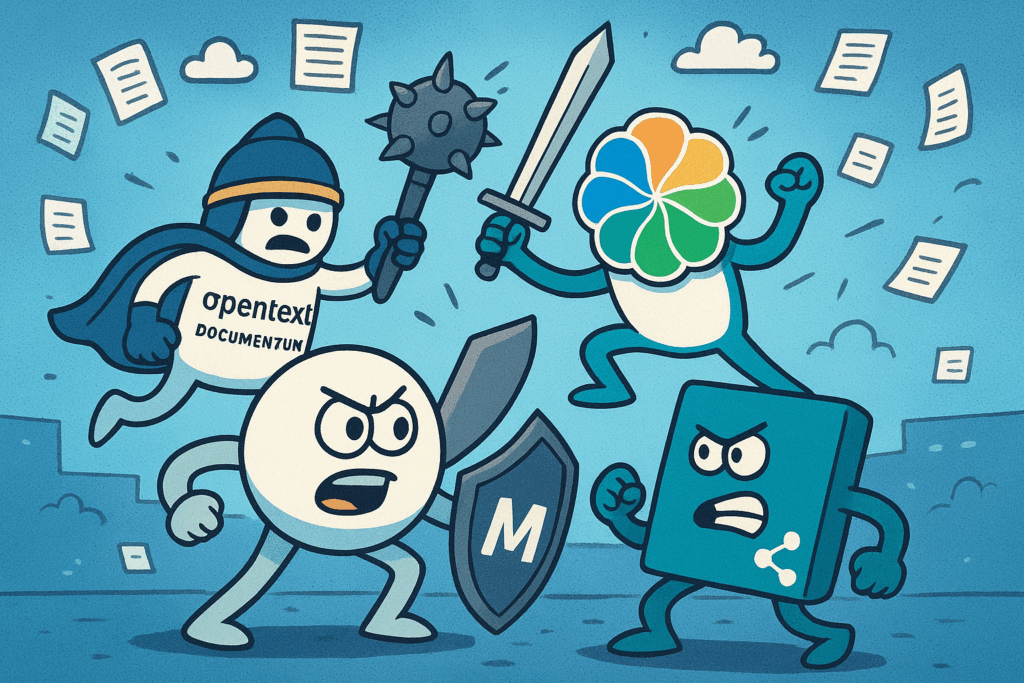
I will compare four leading ECM solutions: M-Files, Microsoft SharePoint, OpenText Documentum, and Alfresco. This will help you determine which solution best fits your business needs. Of course, I haven’t worked with all the market players, so this post will reflect my personal opinions.
To make this comparison meaningful, I’ll evaluate each platform based on following criteria:
Deployment Options (Cloud, On-Premises, Hybrid)
Integration Capabilities
Compliance & Security
Scalability & Performance
Cost & Licensing
User Experience
Platform Overviews
M-Files
M-Files takes a metadata-driven approach to content management, which means documents are organized by “what they are” rather than “where they are stored.” This eliminates silos and makes finding information intuitive.
Key strengths:
- AI-powered metadata and classification
- Strong integrations with Microsoft 365, Salesforce, and ERP systems
- Flexible deployment: Cloud, on-prem, or hybrid
- Lot of automation possibilities
- Excellent compliance features for regulated industries
Best for: Organizations seeking a modern, intelligent ECM with strong automation and compliance capabilities.
Microsoft SharePoint
SharePoint is widely known for its collaboration features and deep integration with the Microsoft ecosystem. It’s often used as an intranet and document management platform.
Key strengths:
- Seamless integration with Microsoft 365 apps
- Strong collaboration tools
- Scalable for enterprise use
- Familiar interface for Microsoft users
Challenges: Requires customization for advanced ECM features; governance can be complex.
Best for: Businesses already invested in Microsoft 365 looking for collaboration and basic ECM.
OpenText Documentum
Recently rebranded as OpenText Documentum Content Management, this solution is a heavyweight in the enterprise content management (ECM) space. It is designed for large enterprises with complex compliance and governance needs.
Key strengths:
- Enterprise-grade security and compliance
- Advanced workflow automation
- Extensive integration options
- Strong support for regulated industries
Challenges: High cost, complex implementation, and steep learning curve.
Best for: Large organizations with strict compliance requirements and big budgets.
Alfresco
Alfresco started as an open-source ECM and remains popular for its flexibility and developer-friendly approach.
Key strengths:
- Open architecture and strong API support
- Flexible deployment options
- Good integration with third-party apps
- Cost-effective compared to OpenText
Challenges: Requires technical expertise for customization; Using community edition may be risky if support is needed.
Best for: Organizations seeking an open, customizable ECM solution with lower licensing costs.
Pros and Cons
| Platform | Pros | Cons |
| M-Files | Metadata-driven, AI-powered, flexible | Licensing cost can be high for Small/Medium organizations |
| SharePoint | Microsoft integration, collaboration | Limited ECM features without customization |
| Documentum | Enterprise-grade compliance, robust | Expensive, complex deployment |
| Alfresco | Open-source flexibility, cost-effective | Requires technical expertise |
Use Case Recommendations
Small to Mid-sized Businesses: M-Files or Alfresco for flexibility and cost-effectiveness.
Microsoft-centric Organizations: Obviously SharePoint is well placed but M-Files too since they recently signed a partnership with Microsoft.
Highly Regulated Industries: OpenText for compliance and governance, then for smaller structure M-Files provides a Quality Management System per-configured.
Tech-savvy Teams: In other words, geeks will appreciate Alfresco because of its open-source benefits, community, and customization capabilities.
Conclusion
Selecting the right ECM is critical for organizations. It affects not only how employees work and collaborate but also how the company preserves its knowledge and intelligence.
The right choice depends on your organization’s size, compliance requirements, budget, and IT capabilities.
It is important to think carefully and make the right choice because changing it requires lengthy, costly migration projects.
So, if you want intelligent automation and metadata-driven organization, go with M-Files.
If you’re already deep in the Microsoft ecosystem, SharePoint is a natural fit but if you also need evolved document management processes M-Files is probably an even better option.
For large enterprises with strict compliance, OpenText is hard to beat.
And if you need flexibility and open-source customization, Alfresco is a strong contender.
Unfortunately, there is no magic answer. But at least you found out who can help point you in the right direction: us.
![Thumbnail [60x60]](https://www.dbi-services.com/blog/wp-content/uploads/2022/08/GME_web-min-scaled.jpg)

![Thumbnail [90x90]](https://www.dbi-services.com/blog/wp-content/uploads/2022/08/ATR_web-min-scaled.jpg)
![Thumbnail [90x90]](https://www.dbi-services.com/blog/wp-content/uploads/2022/08/MOP_web-min-scaled.jpg)