First, for those unfamiliar with the term, low-code is a software development approach that uses visual, drag-and-drop interfaces and pre-built components to create applications, rather than manual coding.
Low-code doesn’t always have a good reputation in the IT world because “real” programmers write code. But why reinvent the wheel?
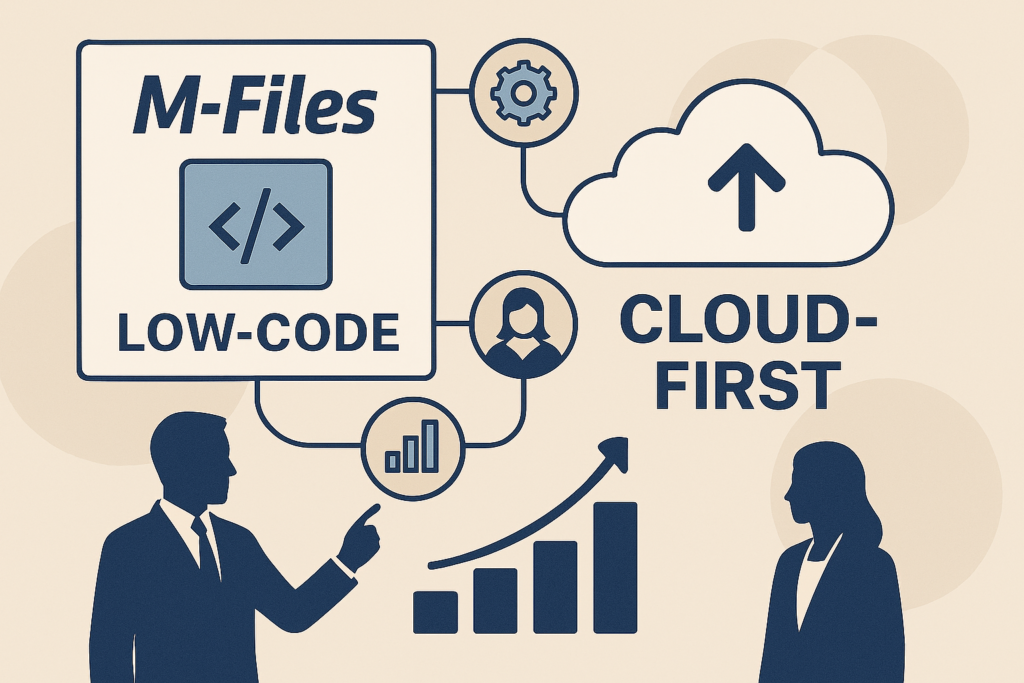
I have worked in the ECM world for more than fifteen years and have seen many organizations rely on heavy custom development to adapt systems to their business needs.
It is often a work habit, but sometimes, it can also be a way of making our work more complicated than it needs to be. Complicating things allows to maintain control over customers (or management for internals) and their need for modifications or maintenance.
However, the reality is that low-code doesn’t mean low competencies. It requires a thorough understanding of existing features and how to optimize them.
The hidden cost of custom development
This is especially true in a cloud environment, where we cannot control the update or upgrade cycle. Updates are frequently pushed (monthly for M-Files), bringing architectural changes, API adjustments, performance optimizations, and security enhancements. Custom code poses a permanent risk of unexpected breakdowns, compatibility issues, authentication errors, and API errors. Sometimes these issues occur silently after an update, and root cause analysis can be difficult.
What worked last month might suddenly stop working tomorrow, and you may not even know until a critical business process fails.
Every custom development requires regression testing, debugging after updates, code refactoring, documentation and QA validation. Since many companies don’t keep the original developer on staff, the risk grows every year.
In contrast, using embedded modules, like Compliance Kit or Properties Calculator for M-Files. They evolve with the platform, not against it.
Another cost factor is security and compliance responsibility. Adding custom code means adding a new piece of software to your ecosystem. You become responsible for its security and must ensure that it complies with data protection rules. Auditors may request documentation and evidence of validation.
On the other hand, native configuration tools are secure by design and part of the editor’s audited code base.
The rise of low-code ECM platforms
To address these issues, modern ECM vendors are moving toward low-code or configuration-driven models.
Low-code ECM platforms focus on:
- configuration instead of custom code
- rules instead of scripts
- metadata-driven logic instead of hard-coded business rules
- cloud compatibility from the ground up
This shift dramatically reduces implementation effort, accelerates time to value, and improves overall system stability.
When low-code matters the most
Low-code ECM becomes critical in situations such as:
- cloud deployments
- rapid prototyping and agile implementations
- regulated environments with strict audit requirements
- organizations with limited IT resources
- multi-country deployments requiring frequent adaptations
In all these scenarios, platforms that rely heavily on custom development struggle.
Low-code ECM thrives.
Where Custom Development Still Has a Role
Low-code doesn’t eliminate custom development, but it changes where it belongs.
Custom code should be used primarily for:
- complex integrations
- external workflow orchestration
- advanced business systems
- analytics or reporting pipelines
But this logic belongs outside the ECM platform, not inside the vault.
This modular approach reduces risk and simplifies lifecycle management.
Low-code is the future
As the ECM landscape accelerates toward cloud-first delivery, the industry is moving away from heavy customization. Organizations are demanding systems that:
- are stable across updates
- reduce maintenance
- accelerate deployment
- adapt quickly
- remain secure and compliant
Low-code ECM is the answer, and M-Files is one of the most advanced platforms in this space thanks to:
- metadata-driven design
- powerful configuration tools
- no-code automation capabilities
- cloud-safe architecture
While many ECM platforms still rely on fragile customizations, M-Files demonstrates that flexibility doesn’t have to mean complexity.
Low-code is no longer a trend, it’s the foundation of modern ECM.
And M-Files is years ahead of many competitors in embracing this approach.
As usual if you want more information about this topic feel free to contact us
![Thumbnail [60x60]](https://www.dbi-services.com/blog/wp-content/uploads/2022/08/GME_web-min-scaled.jpg)

![Thumbnail [90x90]](https://www.dbi-services.com/blog/wp-content/uploads/2022/08/MOP_web-min-scaled.jpg)