

At a customer, I implemented Control-M for Kubernetes/OpenShift, as the customer has a hybrid environment between VM, on-premise/Cloud Kubernetes/OpenShift. This is the first blog of a series, in which I will share with you from A to Z how to implement Control-M for Kubernetes and OpenShift.
Control-M for Kubernetes enables you to execute Control-M job(s) to run one or more pods to completion in a Kubernetes cluster. This enables you to integrate Control-M capabilities, such as advanced scheduling criteria, status monitoring, and SLA management.
In fact, my story with Control-M began before Kubernetes existed, today, as a Control-M and Kubernetes expert I will be able to help you to understand and implement Control-M for Kubernetes. This first blog will be more a quick overview on these technologies and understand the implementation.
To be honest, you will need at least intermediate level on Control-M and Kubernetes to implement smoothly this solution. If you want to know more about Docker and Kubernetes, I would recommend this training.
Control-M Overview
Control-M is a workload automation solution that enables you to automate the scheduling and processing the business workflows across various platforms and applications from a single point of control. Nowadays, those platforms and application could be on VM, Kubernetes cluster, Cloud, etc.
Today, Control-M allow you to execute jobs in almost every platform, but what is a job?
Questions about your own setup? A dbi services consultant can look at your case.
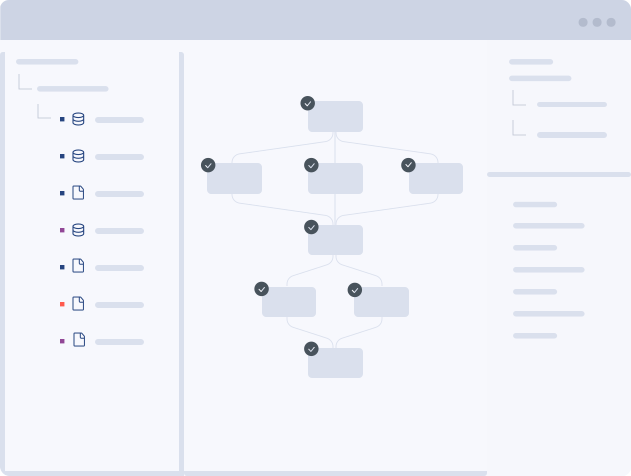
Talk to an expert (opens in a new tab)A job is an execution unit, each job needs specific run information to be executed, such as scheduling criteria, post processing actions, and also job dependencies as shown in the following:
On “legacy” systems, a job could be a script or command, that is executed at the operating system level. On Kubernetes, a job take another role, which allow you at the end to deploy pods in Kubernetes. Let’s get a quick overview on Kubernetes and understand pods 😉
Kubernetes Overview
Kubernetes is a portable, extensible, open source platform for managing containerized workloads and services, that facilitates both declarative configuration and automation. The smallest unit of a Kubernetes application is a pod!
A Kubernetes pod is a collection of one or more Linux containers. Any given pod can be composed of multiple, tightly coupled containers or just a single container.
Control-M for Kubernetes Overview
Now, we understood Control-M jobs and Kubernetes pods, let see how those will be connected.
The following diagram demonstrates how the components of Control-M for Kubernetes are incorporated into a Kubernetes cluster and how they enable you to run one or more pods to completion.
In this example, two Control-M/Agents are deployed as cluster pods.
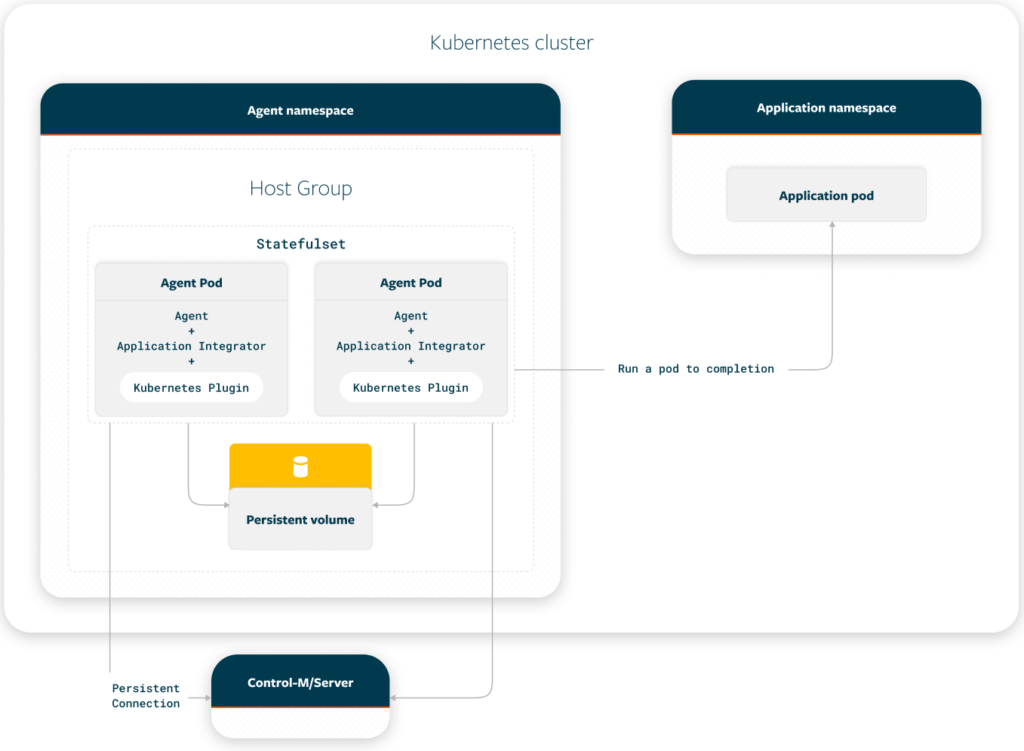
This setup has the following main features:
- The Agent pods run as a StatefulSet, so that the hostname is identified consistently across pod restarts. This enables Control-M/Server to identify the Control-M/Agent continuously and consistently.
- Agent pods use a persistent volume, so that job data and the Control-M/Agent state are kept during pod restarts.
- The Agents belong to a host group, to ensure high availability and load balancing between the Agents.
- Agent to Server communication is set up as a persistent connection that is initiated by the Agent. This prevents the exposure of the Kubernetes cluster to outside connections.
- The Kubernetes plug-in adds a Kubernetes-type job to Control-M, which enables you to run one or more pods to completion in the Application namespace.
But how it works? which component allow us to create a pod inside Kubernetes?
In fact, it is mainly the role of the plug-in, which is responsible for the following stages in the execution of the Kubernetes-type job in Control-M:
- Starts a Kubernetes job entity that runs one or more Application pods in the Application namespace in the Kubernetes cluster.
- From Control-M, monitors the status of the job in Kubernetes until it ends when the Application pods finish running.
- Captures the pod logs for display in the Control-M job output.
- Deletes the Kubernetes job entity to free cluster resources.
Compatibility
Kubernetes
Control-M for Kubernetes is a generic solution for all Kubernetes-based container platforms. The following platforms were tested by BMC:
- RedHat OpenShift
- Amazon Elastic Kubernetes Service (EKS)
- Azure Kubernetes Service (AKS)
Supported versions of Kubernetes: 1.26-1.29
Control-M
Before any action on your system, please insure that you have at least the following versions:
| Component | Minimum version |
| Control-M/EM | 9.0.21.100 |
| Control-M/Server | 9.0.20.200 |
| Control-M Automation API | 9.0.21.305 |
Take a look on the versions that should be installed to implement Control-M for Kubernetes:
| Component | Current Version |
| Control-M | 9.0.21 |
| Helm Chart | 9.0.21.200 |
| Agent image | 9.0.21.200 |
| Control-M Agent | 9.0.21.200 |
| Kubernetes plug-in | 1.0.00 |
| Java | 17 |
Conclusion
We saw together what is Control-M, OpenShift, a quick overview on how Control-M for Kubernetes will be installed, how it will work in general, and the compatibility between all versions!
In the next blog, we will start the implementation of Control-M for Kubernetes.
In the meantime, to enrich your knowledge and be ready for the next step, here are some dbi services blogs around Control-M and Kubernetes.