

By Mouhamadou Diaw
When creating a database in a multitenant environment we must understand how character set works for CDB and PDBS.
In Oracle documentation we can find following lines
-When the character set of the CDB root is AL32UTF8, PDBs that are plugged into the CDB can have a different character set from the CDB root.
PDBs that you create from PDB$SEED inherit the AL32UTF8 character set from it, but you can migrate the PDB to a different character set.
-When the character set of the root is not AL32UTF8, all PDBs in the CDB use the character set of the CDB root.
Let’s see how it works. Suppose I have 2 non-CDB databases DB11G and DB12C and I want to migrate them in an Oracle 21c container.
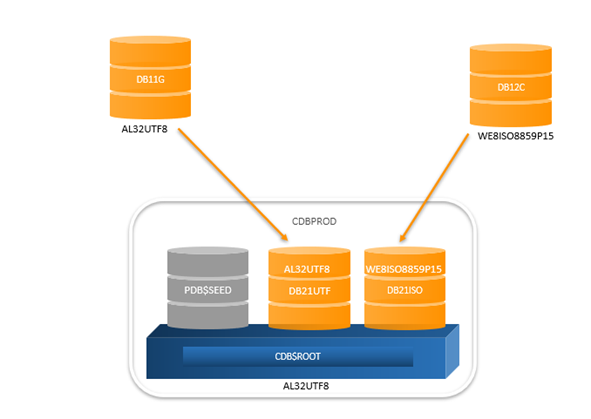
As specified in the documentation we have to create a container with AL32UTF8 as character set. If not, we will not be able to create a PDB with AL32UTF8 as character set.
Ok so the first step is to create the CDB CDBPROD.
|
1
2
3
4
5
6
7
8
9
10
11
12
13
14
15
16
17
18
19
|
SQL> show con_nameCON_NAME------------------------------CDB$ROOTSQL> select name from v$database;NAME---------CDBPRODSQL> select value,parameter from NLS_DATABASE_PARAMETERS where PARAMETER like '%CHARACTERSET';VALUE PARAMETER----------------------------------- -----------------------------------AL16UTF16 NLS_NCHAR_CHARACTERSETAL32UTF8 NLS_CHARACTERSETSQL> |
And in this container CDBPROD let’s create the DB21UTF from seed
|
1
2
3
4
5
6
7
8
9
10
11
12
13
14
15
|
SQL> CREATE PLUGGABLE DATABASE DB21UTF ADMIN USER db21admin identified by root;Pluggable database created.SQL> alter pluggable database DB21UTF open;Pluggable database altered.SQL> show pdbs CON_ID CON_NAME OPEN MODE RESTRICTED---------- ------------------------------ ---------- ---------- 2 PDB$SEED READ ONLY NO 4 DB21UTF READ WRITE NOSQL> |
And in DB21UTF the character set will be same as CDB$ROOT
|
1
2
3
4
5
6
7
8
9
10
11
12
13
14
15
16
17
|
SQL> alter session set container=DB21UTF;Session altered.SQL> show con_name;CON_NAME------------------------------DB21UTFSQL> select value,parameter from NLS_DATABASE_PARAMETERS where PARAMETER like '%CHARACTERSET';VALUE PARAMETER------------------------------ ------------------------------AL16UTF16 NLS_NCHAR_CHARACTERSETAL32UTF8 NLS_CHARACTERSETSQL> |
And then in DB21UTF, I can import data of DB11G.
But how can I create the PDB DB21ISO in CDBPROD with WE8ISO8859P15 as character set. One way is to
-create another CDB CDBISO with the character set WE8ISO8859P15
-create the PDB DBISO in this new CDB CDBISO
-Clone this DBISO in the CDBPROD
Ok let’s do that, below information of the new ISO CDB with the PDB
|
1
2
3
4
5
6
7
8
9
10
11
12
13
14
15
16
17
18
19
20
21
|
SQL> select name from v$database;NAME---------CDBISOSQL> show pdbs CON_ID CON_NAME OPEN MODE RESTRICTED---------- ------------------------------ ---------- ---------- 2 PDB$SEED READ ONLY NO 3 DB21ISO READ WRITE NOSQL> select value,parameter from NLS_DATABASE_PARAMETERS where PARAMETER like '%CHARACTERSET';VALUE PARAMETER------------------------------ ------------------------------AL16UTF16 NLS_NCHAR_CHARACTERSETWE8ISO8859P15 NLS_CHARACTERSETSQL> |
Now let’s clone DBISO in CDBPROD
On CDBISO let’s create a user we will use for a database link
|
1
2
3
4
5
6
7
8
9
10
11
12
13
14
15
|
SQL> show con_nameCON_NAME------------------------------CDB$ROOTSQL> create user c##clone_user identified by root default tablespace users temporary tablespace temp container=ALL;User created.SQL> grant create session, create pluggable database, sysoper to c##clone_user container=ALL;Grant succeeded.SQL> |
On CDBPROD let’s create a database link
Verify your TNS alias
|
1
2
3
4
5
6
7
8
9
10
11
12
13
14
|
oracle@oraadserver:/home/oracle/ [CDBPROD (CDB$ROOT)] tnsping cdbisoTNS Ping Utility for Linux: Version 21.0.0.0.0 - Production on 10-FEB-2022 15:44:03Copyright (c) 1997, 2021, Oracle. All rights reserved.Used parameter files:/u01/app/oracle/network/admin/sqlnet.oraUsed TNSNAMES adapter to resolve the aliasAttempting to contact (DESCRIPTION = (ADDRESS = (PROTOCOL = TCP)(HOST = oraadserver)(PORT = 1521)) (CONNECT_DATA = (SERVER = DEDICATED) (SERVICE_NAME = CDBISO)))OK (0 msec)oracle@oraadserver:/home/oracle/ [CDBPROD (CDB$ROOT)] |
Create the dblink
|
1
2
3
4
5
6
7
8
9
10
11
12
13
14
15
16
17
18
19
20
21
22
23
|
SQL> select name from v$database;NAME---------CDBPRODSQL> show con_nameCON_NAME------------------------------CDB$ROOTSQL> create database link cloneiso connect to c##clone_user identified by root using 'CDBISO';Database link created.SQL> select * from dual@cloneiso;D-XSQL> |
And then clone the DBISO PDB in CDBPROD
|
1
2
3
4
5
6
7
8
9
10
11
12
13
14
15
16
17
18
19
|
SQL> select name from v$database;NAME---------CDBPRODSQL> show con_nameCON_NAME------------------------------CDB$ROOTSQL> create pluggable database DB21ISO from DB21ISO@cloneiso;Pluggable database created.SQL> alter pluggable database DB21ISO open;Pluggable database altered. |
Now let’s verify the state of my PDBs in CDBPROD
|
1
2
3
4
5
6
7
8
9
10
11
12
13
14
15
16
|
SQL> select name from v$database;NAME---------CDBPRODSQL>SQL> show pdbs CON_ID CON_NAME OPEN MODE RESTRICTED---------- ------------------------------ ---------- ---------- 2 PDB$SEED READ ONLY NO 4 DB21UTF READ WRITE NO 7 DB21ISO READ WRITE NOSQL> |
Let’s verify the DB21ISO character set
|
1
2
3
4
5
6
7
8
9
10
11
12
13
14
15
16
17
18
19
20
21
22
|
SQL> select name from v$database;NAME---------CDBPRODSQL> alter session set container=DB21ISO;Session altered.SQL> select value,parameter from NLS_DATABASE_PARAMETERS where PARAMETER like '%CHARACTERSET';SQL> col value for a35SQL> col parameter for a35SQL> select value,parameter from NLS_DATABASE_PARAMETERS where PARAMETER like '%CHARACTERSET';VALUE PARAMETER----------------------------------- -----------------------------------AL16UTF16 NLS_NCHAR_CHARACTERSETWE8ISO8859P15 NLS_CHARACTERSETSQL> |
And the CDBPROD as seen before has AL32UTF8 as character set
|
1
2
3
4
5
6
7
8
9
10
|
SQL> conn / as sysdbaConnected.SQL> select value,parameter from NLS_DATABASE_PARAMETERS where PARAMETER like '%CHARACTERSET';VALUE PARAMETER----------------------------------- -----------------------------------AL16UTF16 NLS_NCHAR_CHARACTERSETAL32UTF8 NLS_CHARACTERSETSQL> |
Conclusion
Always use AL32UTF8 for your CDB if possible, in this way you will be able to have PDBs with different character set