Skip to content

Adrien Obernesser

With more than three years of experience as a Database Administrator specializing in SQL Server and PostgreSQL, Adrien Obernesser focuses on performance tuning. He is skilled at diagnosing issues on customer servers and delivering actionable improvement plans, backed by solid leadership experience in cross-cultural environments. Prior to dbi services, he served as Operations Manager and Consultant DBA at Zen-Conseil. His industry experience spans the defense, telecommunications, and industrial sectors.

29 posts since September 2023

AI problems are database problems

Introduction When discussing agentic AI, we spend a lot of time on the model. Which one should we use? How much context does it support? Can it choose the right tool? These are useful questions. But from a my perspective, there are a few others I would ask quite early. Where does the agent store its state? Who can access… 

AI agents on sensitive data: what PostgreSQL can enforce, and what it can’t

Every useful database content, document behind an internal AI agent names someone, a company, server names,… A relationship manager might ask “what did this client complain about last quarter?”, an operations engineer might ask “what happened on this server last month?”, and the answer sits in notes, emails and incident tickets, CRMs and ERPs data, full of client names, staff… 

Surviving a Patroni failover with logical replication

Your Patroni cluster does exactly what you built it to do. A node dies at 3 a.m., a new primary is elected in a few seconds, the application reconnects, and nobody gets paged. Your HA setup works. And yet, somewhere downstream, your change-data-capture pipeline has just gone quiet. Debezium or Flink CDC was streaming every change out of that database… 

MariaDB 12.3 – Binlog Inside InnoDB

MariaDB has been quite active lately, the version 11.8 was already quite a step forward and apart from the changes on LTS schedule and the EOL durations, the RC 12.3 LTS is bringing some interesting changes to binlogs, pushing even further performance improvements and reliability. Instead of using the traditional flat file binlogs, they can be now integrated into InnoDB… 

pgvector, a guide for DBA – Part 2: Indexes (update march 2026)

Introduction In Part 1 of this series, we covered what pgvector is, how embeddings work, and how to store them in PostgreSQL. We ended with a working similarity search — but on a sequential scan. That works fine for a demo table with 1,000 rows. It does not work for production. This post is about what comes next: indexes. Specifically,… 

RAG Series – Embedding Versioning LAB

Introduction This is Part 2 of the embedding versionin, in Part 1, I covered the theory: why event-driven embedding refresh matters, the three levels of architecture (triggers, logical replication, Flink CDC), and how to detect and skip insignificant changes. If you haven’t read it, go there first, this post won’t through the entire intent of the designs but just demonstrate… 

RAG Series – Embedding Versioning with pgvector: Why Event-Driven Architecture Is a Precondition to AI data workflows

Introduction “Make it simple.” This is a principle I keep repeating, and I’ll repeat it again here. Because when it comes to keeping your RAG system’s embeddings fresh, the industry has somehow made it complicated. External orchestrators, custom Python cron jobs, microservices that call microservices, Airflow DAGs with 47 tasks, all to answer a simple question: when my source data… 

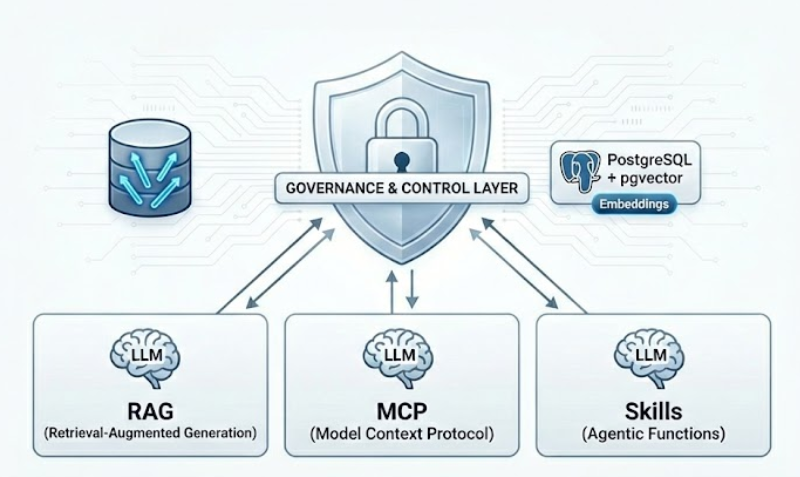
RAG, MCP, Skills — Three Paradigms for LLMs Talking to Your Database, and Why Governance Changes Everything

Introduction Throughout my RAG series, I’ve explored how to build retrieval-augmented generation systems with PostgreSQL and pgvector — from Naive RAG through Hybrid Search, Adaptive RAG, Agentic RAG, and Embedding Versioning (not yet released) . The focus has always been on retrieval quality: precision, recall, nDCG, confidence. But I want to take a step back. In conversations with colleagues, clients,… 

Oracle to PostgreSQL Migration with Flink CDC

Introduction When wanting to migrate from the big red to PostgreSQL, most of the time you can afford the downtime of the export/import process and starting from something fresh. It is simple and reliable. Ora2pg being one of the go-to tools for that. But sometimes, you can afford the downtime, either because the database is critical for business operations or… 

RAG Series – Agentic RAG

Introduction In earlier parts, we moved from Naive RAG (vector search) to Hybrid RAG (dense + sparse) to Adaptive RAG (query classification and dynamic weighting). Each step improved what we retrieve. Agentic RAG goes further: the LLM decides if and when to retrieve at all and can take multiple steps (retrieve → inspect → refine → retrieve) before answering. Retrieval… 

pgconf.eu 2025 – RECAP

I was fortunate to be able to attend at the pgconf.eu 2025. This year event was happening in RIGA and joined together once again key members of the community, contributors, committers, sponsors and users from across the world. I would summarize this year event with those three main topics : AI/LLM – PG18- Monitoring. AI/LLMs Compared to last year the… 

RAG Series – Adaptive RAG, understanding Confidence, Precision & nDCG

Introduction In this RAG series we tried so far to introduce new concepts of the RAG workflow each time. This new article is going to introduce also new key concepts at the heart of Retrieval. Adaptive RAG will allow us to talk about measuring the quality of the retrieved data and how we can leverage it to push our optimizations…