Skip to content

SQL

SQL Tuning – Mix NULL / NOT NULL Values

One of the difficulty when writing a SQL query (static SQL) is to have in the same Where Clause different conditions handling Null Values and Not Null Values for a predica. Let’s me explain you by an example : Users can entered different values for a user field from an OBI report: – If no value entered then all rows… 

A tribute to Natural Join

By Franck Pachot . I know that lot of people are against the ANSI join syntax in Oracle. And this goes beyond the limits when talking about NATURAL JOIN. But I like them and use them quite often. Why is Natural Join bad? Natural join is bad because it relies on column names, and, at the time of writing the… 

SQL Server 2017: TRIM not only a replacement of RTRIM and LTRIM

Last month, I present in the IT-Tage 2017 in Frankfurt am Main, a session about SQL Server 2017 overview. During my session I made a demo on one of the new string T-SQL Commands: TRIM. My demo was very simple but I have also 2 very good questions. Before, I write about these question, I will show you what is… 

Documentum – DFC traces setup & investigation

When working with Documentum, you will most probably have to enable the DFC traces one day or another and then work with these traces to analyze them. The purpose of this blog is simply to show how the DFC traces can be enabled, which tools can be used to quickly process them and what are the limitations of such things.… 

“_suppress_identifiers_on_dupkey” – the SAP workaround for bad design

By Franck Pachot . In SQL, ‘upsert’ is a conditional insert or update: if the row is there, you update it, but if it is not there, you insert it. In Oracle, you should use a MERGE statement for that. You are clearly doing it wrong if you code something like: begin insert… exception when dup_val_on_index then update… end; But… 

APEX Connect 2017 – Day 1

This year again the APEX connect conference spans over three days with mixed topics around APEX, like JavaScript, CSS, SQL and much more. After the welcome speech and the Keynote about “Reconciling APEX and the Thick Database Paradigm” by Bryn Llewellyn I decided to attend presentations on following topics: – Temporal Validity and Flashback Data Archive – Universal Theme and… 

How to destroy your performance: PL/SQL vs SQL

Disclaimer: This is in no way a recommendation to avoid PL/SQL. This post just describes a case I faced at a customer with a specific implementation in PL/SQL the customer (and me) believed is the most efficient way of doing it in PL/SQL. This was a very good example for myself to remind me to check the documentation and to… 

Oracle 12cR2 SQL new feature: LISTAGG overflow

By Franck Pachot . LISTAGG was a great feature introduced in 11g: put rows into line with a simple aggregate function. 12cR2 adds an overflow clause to it. What happens when you have so many rows that the LISTAGG result is too long? SQL> select listagg(rownum,’,’)within group(order by rownum) from xmltable(‘1 to 10000′); select listagg(rownum,’,’)within group(order by rownum) from xmltable(‘1… 

Oracle serializable is not serializable

By Franck Pachot . Did you know that when you set isolation level to SERIALIZABLE, it is not serializable but SNAPSHOT? This isolation level is lower than serializable. I’ve never thought about it until I read Markus Winand slides about transactions. I recommend every developer or DBA to read those slides. This post is there to illustrate write skew in… 

Nulls in composite keys

By Franck Pachot . Comparison of NULL can be misleading and it’s even worse for unique constraint validation. Having partial nulls in a composite key can be tricky because the SQL ANSI specification is not very easy to understand, and implementation can depend on the RDBMS. Here is an example with composite unique key and foreign key on Oracle. Unique… 

SQL Server 2016: new T-SQL commands COMPRESS and DECOMPRESS

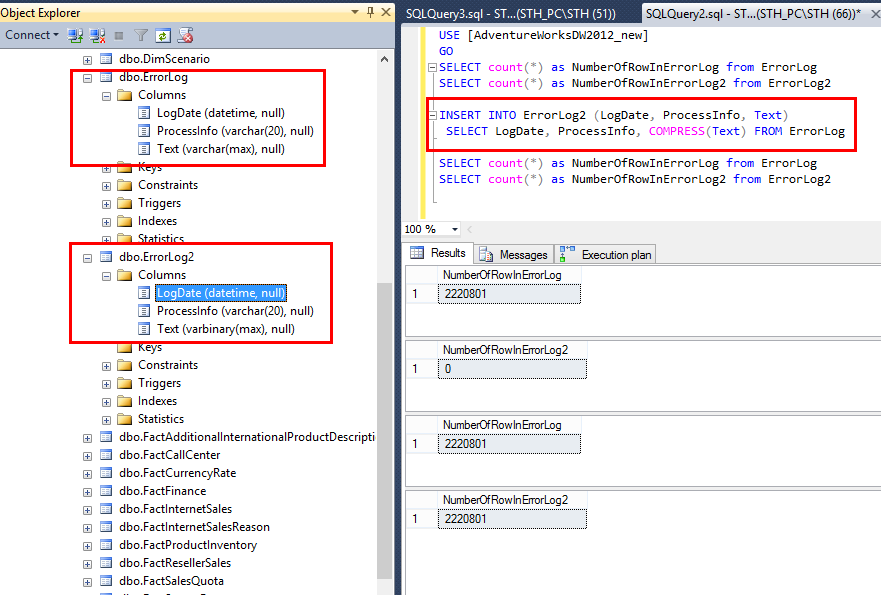
In live from the JSS2015 (Journée SQL Server 2015) in Paris, we saw that the CTP3.1 has been available in the night of these 2 days. One new feature available for this release in the T-SQL domain is COMPRESS and DECOMPRESS. Through a GZIP algorithm, you can compress and decompress an argument for nvarchar, varchar, varbinary, char and binary data… 

Parallel sequential scans are coming to PostgreSQL

It didn’t made it into the upcoming PostgreSQL 9.5 release but it will probably be coming in 9.6: Parallel sequential scans. If you take a look at the development documentation some new parameters showed up: max_parallel_degree: The maximum degree of parallelism for an individual parallel operation. parallel_tuple_cost: Sets the planner’s estimate of the cost of transferring a tuple from a…