Skip to content

RAG

pgvector, a guide for DBA – Part 2: Indexes (update march 2026)

Introduction In Part 1 of this series, we covered what pgvector is, how embeddings work, and how to store them in PostgreSQL. We ended with a working similarity search — but on a sequential scan. That works fine for a demo table with 1,000 rows. It does not work for production. This post is about what comes next: indexes. Specifically,… 

RAG Series – Embedding Versioning LAB

Introduction This is Part 2 of the embedding versionin, in Part 1, I covered the theory: why event-driven embedding refresh matters, the three levels of architecture (triggers, logical replication, Flink CDC), and how to detect and skip insignificant changes. If you haven’t read it, go there first, this post won’t through the entire intent of the designs but just demonstrate… 

RAG Series – Embedding Versioning with pgvector: Why Event-Driven Architecture Is a Precondition to AI data workflows

Introduction “Make it simple.” This is a principle I keep repeating, and I’ll repeat it again here. Because when it comes to keeping your RAG system’s embeddings fresh, the industry has somehow made it complicated. External orchestrators, custom Python cron jobs, microservices that call microservices, Airflow DAGs with 47 tasks, all to answer a simple question: when my source data… 

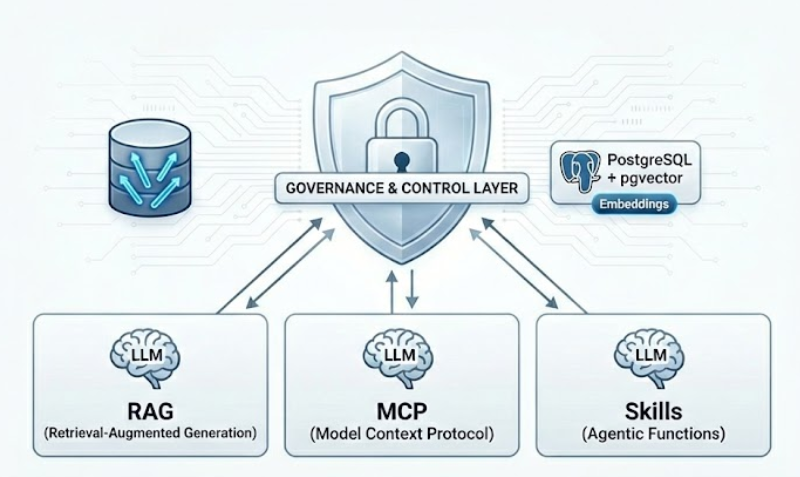
RAG, MCP, Skills — Three Paradigms for LLMs Talking to Your Database, and Why Governance Changes Everything

Introduction Throughout my RAG series, I’ve explored how to build retrieval-augmented generation systems with PostgreSQL and pgvector — from Naive RAG through Hybrid Search, Adaptive RAG, Agentic RAG, and Embedding Versioning (not yet released) . The focus has always been on retrieval quality: precision, recall, nDCG, confidence. But I want to take a step back. In conversations with colleagues, clients,… 

SQL-Server 2025: Building a RAG Shopping Assistant with T-SQL

In this post, we continue our AI journey with SQL Server 2025 (Preview). In previous articles, I already showed how to call the GPT-4o chat-completion model in Azure directly from SQL Server to generate product descriptions, how to create and store embeddings for semantic search, and how to use the (preview) acceleration features for semantic search workloads. If you want… 

RAG Series – Hybrid Search with Re-ranking

Introduction In the first part of this RAG series, we established the fundamentals of Naive RAG with dense vector embeddings on PostgreSQL using pgvector. That foundation works well for conceptual queries, but production systems quickly reveal a limitation: pure semantic search misses exact matches like you would have with like or Full-text searches. When someone searches for “PostgreSQL 17 performance… 

RAG Series – Naive RAG

Introduction Since my last series on pgvector I had quite a fun time to work on RAG workflows on pgvector and learned some valuable lessons and decided to share some of it in a blog post series on the matter. We will discover together where all RAG best practices are landing for the past 2 years and how can as…