
Skip to content

PostgreSQL

PostgreSQL from installation to production: configuration, streaming replication, high availability with Patroni, backups with pgBackRest, performance tuning, extensions, upgrades and migrations from other database engines.

bulk loading semi structured data in postgresql

The last post took a look at how to efficiently load 1m rows into a table in PostgreSQL. In this post I’ll take a look on how to do the same with semi structured data. Again it is the same system as in the last post using the same PostgreSQL parameters. Using the hstore datatype For storing key/value pairs there… 
Variations on 1M rows insert(2): commit write – PostgreSQL

Franck was quite fast with his second post Variations on 1M rows insert(2): commit write. Lets see what we can do on the PostgreSQL side. I’ll take the same test table as Franck again: create table DEMO (“id” number , “text” varchar2(15), “number” number) ; The pgplsql block which corresponds to Frank’s plsql block looks like this: \timing on truncate… 

Variations on 1M rows insert (1): bulk insert – PostgreSQL

When I read Franck’s post about Variations on 1M rows insert (1): bulk insert I thought doing quite the same in PostgreSQL might be interesting. Lets start by using the same test tables, one using a primary key and the other one without a primary key:create table DEMO (“id” int , “text” varchar(15), “number” int); create table DEMO_PK (“id” int… 

PostgreSQL : Qu’ai-je installé, Où sont mes données ?

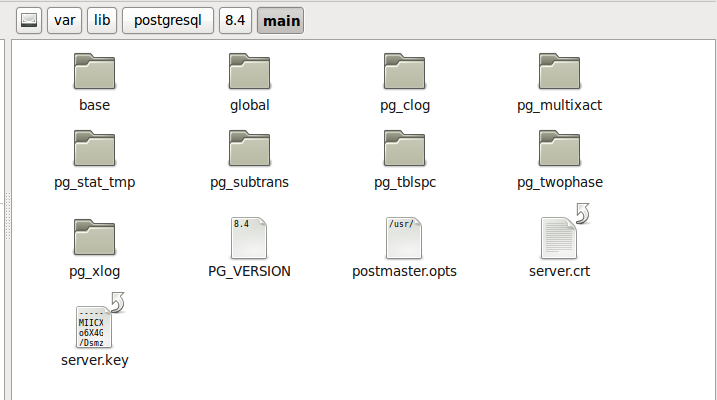
Dans mon dernier article sur PostgreSQL, j’ai présenté l’installation du logiciel en explorant les 2 solutions suivantes, l’installation Debian et l’installation EntrepriseDB. Ces deux installations créent immédiatement un cluster de base de données, Debian nous imposant le point de stockage et EntrepriseDB nous proposant de saisir une destination. Je vous propose maintenant d’explorer ce qui a été installé sur votre

… 

PostgreSQL: une présentation

En 2012, les principaux systèmes de gestion de bases de données relationnelles (SGBDR) sur le marché sont propriétaires. Nous parlons régulièrement d’Oracle Database, MySQL, Microsoft SQL Server. En dehors de ces solutions commerciales, il existe un SGDBR open-source largement utilisé: il s’agit de PostgreSQL et il est l’objet de cet article.