Skip to content

Database

Everything our consultants learn while running databases for customers: Oracle, PostgreSQL, SQL Server, MySQL, MariaDB, MongoDB and Delphix. Expect hands-on posts about installation, day-to-day administration, backup and recovery, performance tuning, replication and upgrades.

Oracle 12c CDB – metadata & object links internals

By Franck Pachot . Warning: this is only geek stuff about internals on multitenant database dictionary, metadata, and object links. It has nothing to do with the operations that you can do on your database. Don’t try that in production or you can corrupt the whole dictionary. In 12 multitenant database (aka CDB) we know that each pluggable database is… 
AWR Formatter: plug-in Google Chrome pour rapports AWR

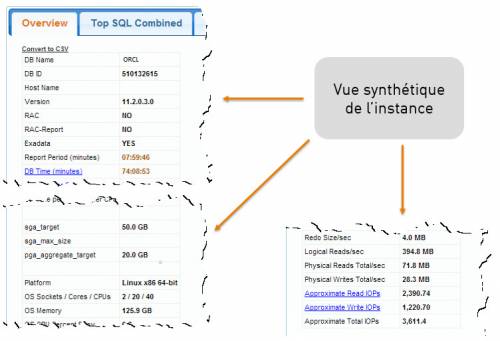
Chacun d’entre nous à une façon bien différente d’appréhender le rapport AWR (Oracle Automatic Workload Repository). Nous utilisons nos propres processus de lecture et notre propre appoche. Dans ce blog je vous propose de découvrir AWR Formatter, un outil qui permet de concentrer les informations en quelques clics. Il s’agit d’un plug-in (AWR-Format.crx) pour Google Chrome fort sympatique, qui permet… 

SQL Server 2014: In-Memory tables, Bw-Tree, and storage

SQL Server 2014 introduces hash indexes with in-memory optimized tables. I described some of their aspects in a previous blog post.  These indexes are very efficient with lookup search operations but have some limitations with operations like range scans, inequality predicates or scan order operations. These limitations are linked to hash index design that stores rows in the index in… 

Oracle TNS_ADMIN issues due to bad environment settings

Recently, I faced a TNS resolution problem at a customer. The reason was a bad environment setting: The customer called the service desk because of a DBLINK pointing to a bad database. The users were supposed to be redirected to a development database, and the DBLINK was redirecting to a validation database instead. The particularity of the environment is that development… 

Oracle 12c Adaptive Plan & inflection point

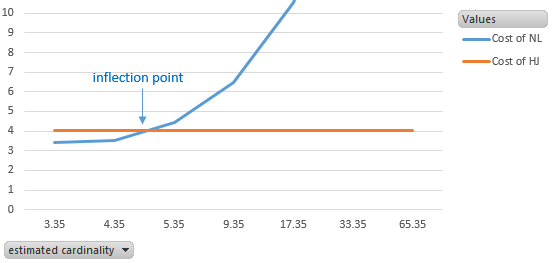
By Franck Pachot . The Oracle 12c Adaptive Plan feature was already presented by Nicolas Jardot in OOW 2013: Solving customer issues with the 12c Optimizer. I recently had to answer several questions about its behavior at execution time. Maybe the term ‘adaptive’ is misleading. It’s not that a join will stop and restart to another join method. Even with… 

Best practice for the sending of an Oracle execution plan

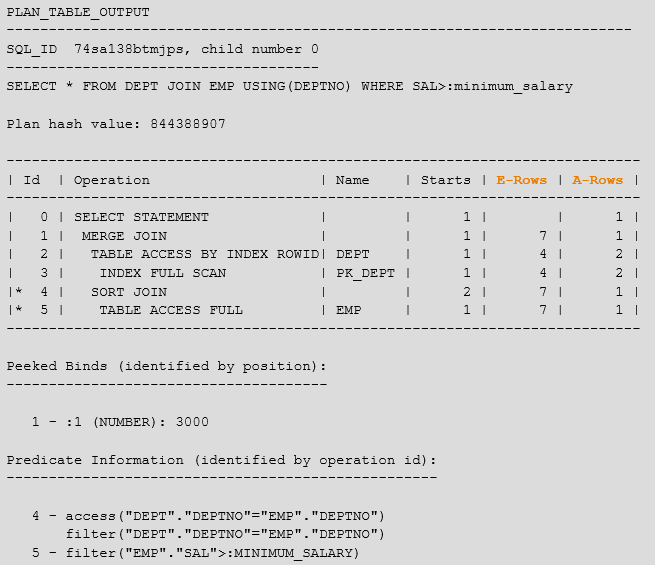
By Franck Pachot . You have a query that takes too long and you want help to analyze the execution plan? Then you need to get it with relevant information, and correctly formatted. Autotrace is not a good option as it does not bind the variables in the same way as your application. Explain plan only shows estimations, but if… 

Transparent data encryption, key management and backup strategies

Transparent Data Encryption requires the creation of a database key encryption. The database key is a part of the hierarchy of SQL Server encryption tree with at the top of the tree the DPAPI. Then if we traverse the tree from the top to bottom we can find the service master key, the database master key, the server certificate or… 

The consequences of NOLOGGING in Oracle

By Franck Pachot . While answering to a question on Oracle forum about NOLOGGING consequences, I provided a test case that deserves a bit more explanation. Nologging operations are good to generate minimal redo on bulk operations (direct-path inserts, index creation/rebuild). But in case we have to restore a backup that was made before the nologging operation, we loose data.… 

SQL Server 2014: Buffer pool extension – an interesting new feature

Buffer pool extension (aka BPE) is an interesting feature of SQL Server 2014. Database administrators already know that memory is one of the key assets available for SQL Server. This is especially true for buffer pool memory, which plays an important role in storing data page and reducing the I/O demand. Nowadays, even if the memory has become cheaper, we… 

Investigating Oracle lock issues with event 10704

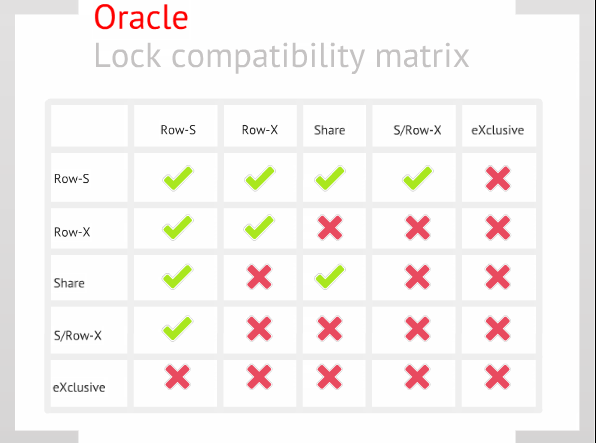
By Franck Pachot . Did you ever encounter unexplained Oracle lock issues? They may be coming from unindexed foreign keys (which is worse in 11g). It’s not easy to monitor. Of course you can check Oracle locks from V$LOCKED_OBJECT, but that is a solution only for locks that remain. Some Oracle locks are there only for a short duration. How do you… 

SQL Server 2014: Deleting files of a hekaton table

A recurrent question I have often heard about Hekaton objects is the following: Is an accidental deletion of the compilation files of a hekaton table on the file system irreversible and could this compromise the execution of SQL Server? To check the SQL Server behaviour in such situation, we can perform the following test with an in-memory optimized table: CREATE…