Skip to content

Database

Everything our consultants learn while running databases for customers: Oracle, PostgreSQL, SQL Server, MySQL, MariaDB, MongoDB and Delphix. Expect hands-on posts about installation, day-to-day administration, backup and recovery, performance tuning, replication and upgrades.

SQL Server monitoring with nagios: installation

Nagios is an IT Infrastructure monitoring solution which is able to monitor SQL Server instances with a specific plugin. I have installed this plugin to test those functionalities and I will explain here how to do it. Prerequisites installation FreeTDS installation FreeTDS is a set of libraries for Unix and Linux that allows your programs to natively talk to Microsoft… 
Security via policies

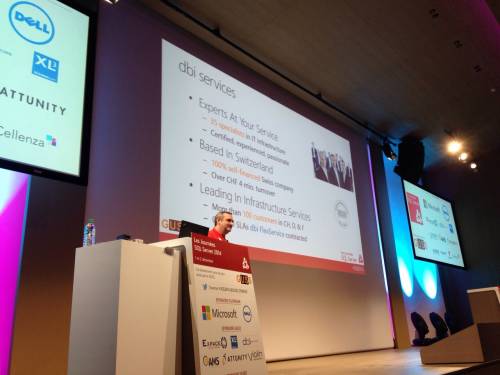
Few weeks ago, I presented the session on security via Policies for “Les journées SQL Server 2014”, organized by the French SQL Server User Group (GUSS) in Paris. I promised to post our policies script on a blog. Security Policies are split into 4 categories: Server Instance Database Data All policies follow this naming convention: dbi_”Level number”_”Level name”_”Policy name” I… 

Never gather WORKLOAD stats on Exadata…

By Franck Pachot . For Exadata, oracle has introduced an ‘EXADATA’ mode which sets a high transfer rate (with IOTFRSPEED as in NOWORKLOAD statistics) and set a MBRC (as in WORKLOAD statistics). Those values are set rather than gathered because all the SmartScan optimization done at storage cell level, which makes the multiblock reads less expensive, is difficult to measure… 

Oracle multitenant dictionary: rowcache

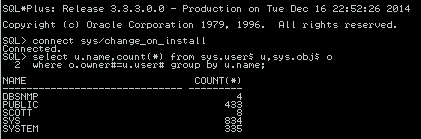
By Franck Pachot . I’ve not finished with my investigation on 12c multitenant dictionary. Here, I’m checking how metadata links are managed by the dictionary cache (aka rowcache). As I did previously, I’ll create a metadata link function in my lab environment (this is not for production. For the moment metadata/object links are supported only for oracle objects). SQL> connect… 

IOUG Collaborate #C15LV

By Franck Pachot . The IOUG – Independant Oracle User Group – has a great event each year: the COLLABORATE. This year it’s in April 12-16, 2015 at The Mandalay Bay Resort & Casino in Las Vegas. I’ll be a speaker and a RAC Attack Ninja as well.  IOUG COLLABORATE provides all the real-world technical training you need – not… 

Flush one SQL statement to hard parse it again

By Franck Pachot . If you want a statement to be hard parsed on its next execution, you can flush the shared pool, but you don’t want all the cursors to be hard parsed. Here is how to flush only one statement, illustrated with the case where it can be useful. During the performance training, here is how I introduce… 

Stay with non-CDB or go to CDB?

By Franck Pachot . This is a question that starts to be raised quite frequently. Oracle released the multitenant architecture 1.5 year ago. And now says that the previous architecture – known as non-CDB – is deprecated. What does it mean? Do we have to go to the CDB architecture even if we don’t want to use/pay multi-tenant? It started… 

When to gather workload system statistics?

By Franck Pachot . This month we started to give our Oracle Tuning Workshop. And with a new workshop comes new questions. We advise to give to the optimizer the most accurate statsistics that we can have. That suggests that WORKLOAD statistics are better than NOWORKLOAD ones because they gather the average number of blocks read in multiblock read, rather… 

Oracle OPatch and “Archive not applied” error

Recently, I have installed an Oracle 11.2.0.4 RDBMS on a server, and I wanted to install the latest Patch Set Update (PSU) 11.2.0.4.4 from October 2014. During the execution, I fell on the error “Archive not applied” and the job failed. This is how to quickly fix this issue. While installing the PSU 11.2.0.4.4 from October 2014 on my Oracle… 

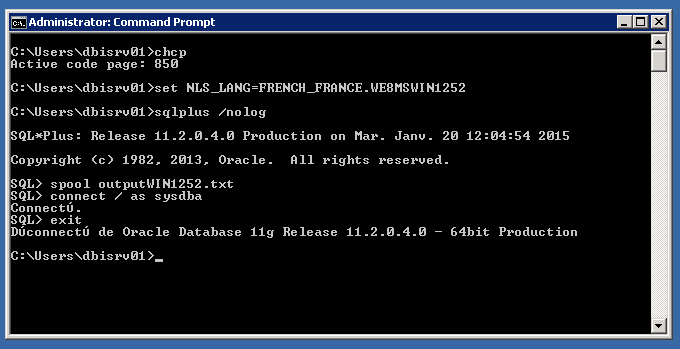
NLS_LANG on Windows in Europe: WE8MSWIN1252 or WE8PC850?

By Franck Pachot . In europe we have accents and non US7ASCII characters. We need special characterset. I’m not talking about Unicode here that solves all the problems. If you have a Java application, you have no problem: it’s Unicode. You can store all characters in one multi-byte characterset. But for other applications, on Windows, you have 2 possible charactersets…