Welcome to Valencia!
This year, the European PostgreSQL conference, PGConf.EU, takes place at the Palacio de Congresos in Valencia, Spain. I am lucky to be able to attend it with some colleagues from dbi services. Let’s see what’s going on there…
I started the first day with a quick tour of the both of the different conference sponsors.
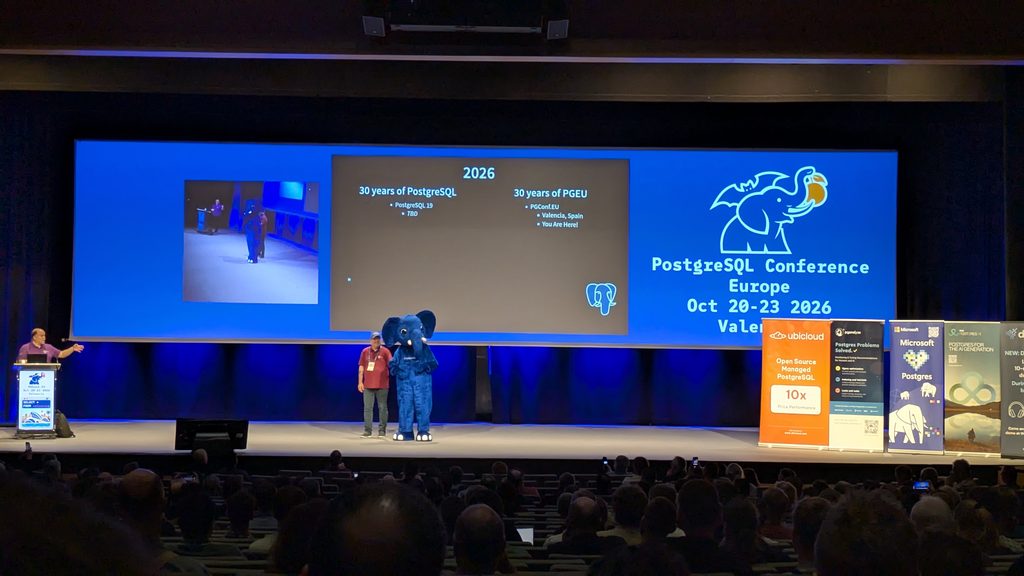
I then joined the main auditorium for the welcome session, presented by Magnus Hagander.
After sharing some information about the organization and how the conference would run, Magnus gave a nice overview of the history of PostgreSQL and PGConf. I found it very interesting to discover the history and evolution of the different conferences.
Even Slonik came on stage to give us a shy hello 🙂
During the coffee break, I went to watch a live demo at the DBtune stand.
DBtune is a tool that uses AI to automatically optimize PostgreSQL performance. It analyzes the database workload and adjusts server parameters to improve performance and resource usage, with the goal of reducing costs and manual work.
Extensions
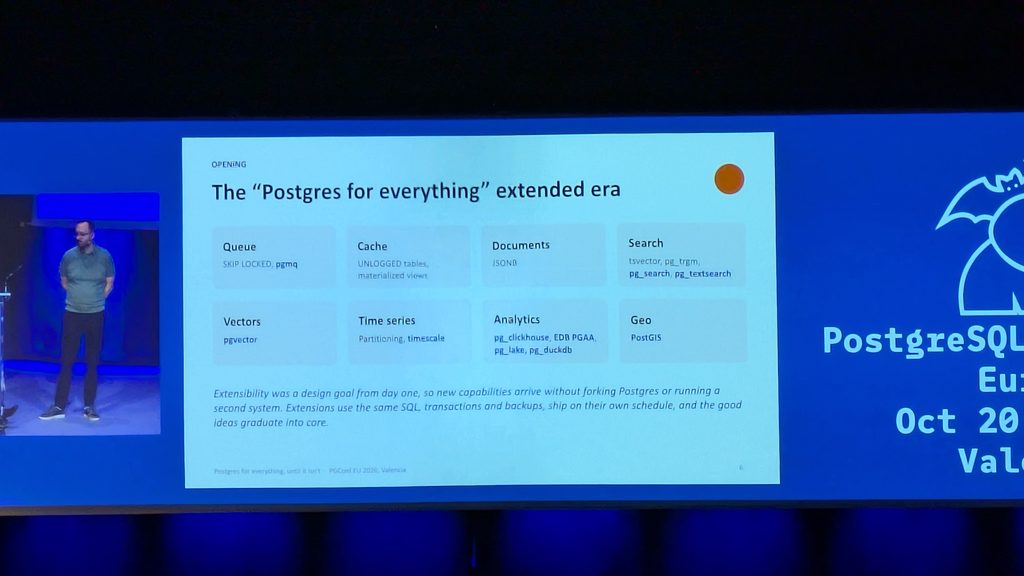
The morning continued with a session presented by Gülcin Yildirim Jelinak and Petr Jelinek. The goal of their presentation was to explain the main strengths of PostgreSQL’s execution model for OLTP workloads, such as MVCC, vacuuming and WAL management. They also explained the limitations of these mechanisms when dealing with large amounts of data, either for writing or for analytics.
The two speakers explained that, in some configurations, PostgreSQL can work as a transactional control layer and an SQL interface, while specialized systems handle execution tasks that are different from traditional OLTP workloads. Many of these solutions are available as extensions, such as pg_search, pg_lake, pg_duckdb and pg_clickhouse. These extensions integrate external execution engines directly with PostgreSQL.
Speaking of extensions, the next session I attended was entirely dedicated to this topic. It was presented by Ebru Aydin Gol, who talked about different approaches and best practices for managing changes and updates to extensions while keeping backward compatibility as much as possible. The general idea is to systematically classify all changes according to their impact on backward compatibility and on the behavior experienced by users.
New features and pgBackRest
I then went to see my former colleague Franck Pachot, who presented some new features of PostgreSQL 19, which we hope will be released very soon! 😉
The new features were presented through live demos. Many of them focused on performance improvements, especially thanks to changes in the query planner.
Franck finished his session by talking about pg_durable, an extension that allows workflows to be defined and executed directly in the database. If a crash happens, it can resume the workflow from where it stopped. This is an interesting extension that could make tools such as pg_cron or other external orchestrators unnecessary for some use cases.
After the afternoon break, I attended a session that was a little less technical but just as interesting. It was about the different ways to implement pgBackRest in high-availability environments.
Stefan Ferot presented several pgBackRest deployment patterns, starting with the simplest solution (one PostgreSQL host connected to one pgBackRest repository host) and moving to the most robust solution.
The most robust architecture uses cloud storage, such as S3, to store archived WAL files directly, together with a repository host that pulls backups from the standby server. This architecture offers several advantages. It removes the SPOF related to on-premises WAL archiving and provides centralized backup orchestration through the repository host.
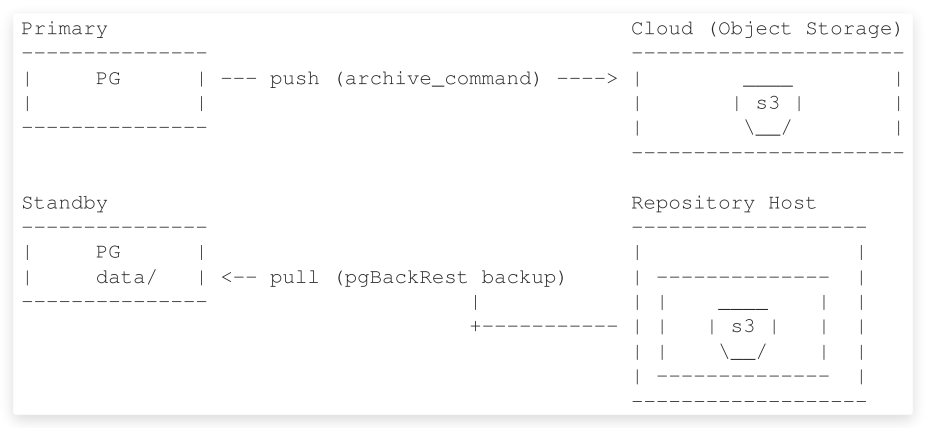
I particularly appreciated that Stefan highlighted the different pgBackRest parameters to consider on both the PostgreSQL hosts and the repository host for each architecture he presented. Despite this, I would have liked to see a demo showing the resilience of the most robust architecture.
Migration
My day ended with a presentation about an Oracle to PostgreSQL migration project of a platform providing more than 500 services to citizens of an Indian state. Hari Kira explained how they handled the rewriting and migration of Oracle-dependent code, the use of ora2pg and its limitations, as well as the main strategic decisions and different project steps.
In the end, everything was migrated to a single PostgreSQL instance, with Patroni, etcd and HAProxy providing high availability.
A few thoughts after day one
My first impressions of PGConf.EU are very positive. The atmosphere is relaxed and friendly, and the conference is very well organized. The technical sessions are very interesting, with several talks about the new features coming in PostgreSQL 19. I also noticed that there were very few sessions about AI, which is quite surprising nowadays.
Overall, this conference is a great opportunity to learn new things and share experiences with the PostgreSQL community.
Let’s go for the second day!