Skip to content

PDB

Multitenant thin provisioning: PDB snapshots on ACFS

By Franck Pachot . Database on ACFS is a long story. At first, the main reason for ASM was to bypass a filesystem layer that is not required by the database. ACFS was for the non-database files that had to be accessed by all cluster nodes. But then, storage vendors and other providers came with snapshots, compression and thin provisioning… 
ODA X6 database classes and shapes

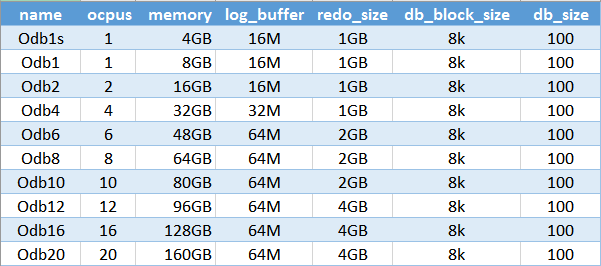
By Franck Pachot . On the Oracle Database Appliance, like on the Oracle public Cloud, you define the CPU capacity with ‘shapes’. On the latest ODA, the X6, we have a new interface to provision a database. Let’s look at the different shapes available. ODACLI You can provision a new database with the command line ODACLI which replaces the OAKCLI… 

Unplugged pluggable databases

By Franck Pachot . When Oracle Multitenant came out in 12c, with pluggable databases, it was easy to draw them as USB sticks that you can plug and unplug to/from your Container Database (CDB). I don’t like this because it gives the false idea that an unplugged database is detached from the container. Containers In the Oracle documentation, the Concept… 

Multitenant internals: object links on fixed tables

By Franck Pachot . The previous post partly answered to the original question (why an object link to V$SESSION is refreshed only every 30 seconds): recursive queries on shared=object views. Now let’s see what is different with fixed tables. Disclaimer: this is research only. Don’t do that anywhere else than a lab. This is implicit when the title is ‘internals’.… 

Multitenant internals: how object links are parsed/executed

By Franck Pachot . I had a comment on object links internals when creating a sharing=object view on GV$SESSION. Before posting about this specific case, I realized that I’ve never explained how a query on an object link is run on the CDB$ROOT container. Data link testcase Here is how I create the DEMOT table and DEMOV view as object… 

Oracle Public Cloud patch conflict

By Franck Pachot . This morning I wanted to test a patch (18633374) in the Oracle Cloud Service. The DBaaS was created as an ‘Enterprise Edition Extreme Performance’ which comes with all options, including multitenant option. I applied my patch. My test required to create a new tablespace but it failed with: ORA-65010: maximum number of pluggable databases created This… 

Oracle Multitenant feature name

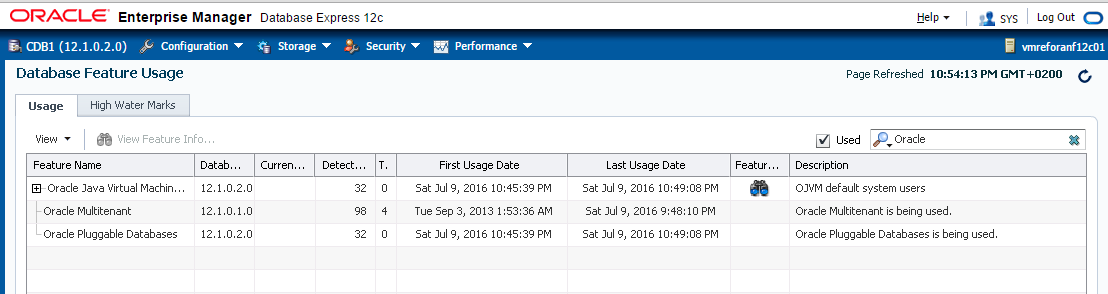
By Franck Pachot . We all know what is the multitenant option: a container database (CDB) with multiple user pluggable databases (PDB). This requires Enterprise Edition plus option. But you can use the same architecture without the option and even in Standard Edition: a CDB with only one user PDB. It is called “single-tenant” or “lone PDB”. How do you… 

Question is: upgrade now to 12.1.0.2 or wait for 12.2 ?

By Franck Pachot . Let’s look at Release Schedule of Current Database Releases (Doc ID 742060.1) 12.2.0.1 is planned for 2HCY2016 on platforms Linux x86-64, Oracle Solaris SPARC (64-bit), Oracle Solaris x86-64 (64-bit). 2HCY2016 starts next week but we can imagine that it will not be released immediately and anyway we will have to wait a few months to download… 

ODA X6-2S and ODA X6-2M for EE and SE2

By Franck Pachot . After the announcement of the death of SE1 and SE we wondered what Oracle will do for Small and Medium Enterprises and entry level products. The answer was postgres the Oracle Cloud Services, but that’s for dev/test only because Public Cloud is not for production and SME will not build a Private Cloud for their few… 

DB_FLASHBACK_RETENTION_TARGET may hang your database

By Franck Pachot . DB_FLASHBACK_RETENTION_TARGET is set to keep enough flashback logs to be able to flashback database within the specified retention window. But it’s supposed to be a target only, meaning that on space pressure some files can be deleted. But be careful, there are cases where they are not and then the database hangs until you set a… 

Multitenant dictionary: what is stored only in CDB$ROOT?

By Franck Pachot . Multitenant architecture is about dictionary separation. The idea is that all system metadata is stored only in CDB$ROOT so that space and upgrade time are optimized. Is it entirely true? let’s count the rows in the dictionary tables. In order to verify that, I’ve build a query that will count the rows from the dictionary tables,… 

Single-Tenant vs. non-CDB: no reason to refuse it

By Franck Pachot . When non-CDB has been declared deprecated, I was a bit upset because multitenant with a lone PDB just looks like an overhead of 3 containers instead of one. But with experience I changed my mind. First because the multitenant architecture brings some features that are available even without the option. And second, because this overhead is…