Skip to content

Oracle 12c

Oracle 12cR2 – DataGuard and the REDO_TRANSPORT_USER

By William Sescu In a DataGuard environment, by default, the password of the SYS user is used to authenticate redo transport sessions when a password file is used. But for security reasons you might not want to use such a high privileged user only for the redo transmission. To overcome this issue, Oracle has implemented the REDO_TRANSPORT_USER initialization parameter. The… 

Oracle 12c – RMAN and Unified Auditing – Does it really work?

By William Sescu The new Oracle Unified Auditing feature, audits RMAN operation per default as soon as you relink your Oracle binary and start your instance. A quite cool new feature, because it allows me to audit RMAN operation out of the box. For example, someone could create a RMAN backup to ‘/tmp’ and then copy it to somewhere else.… 

Multitenant internals – Summary

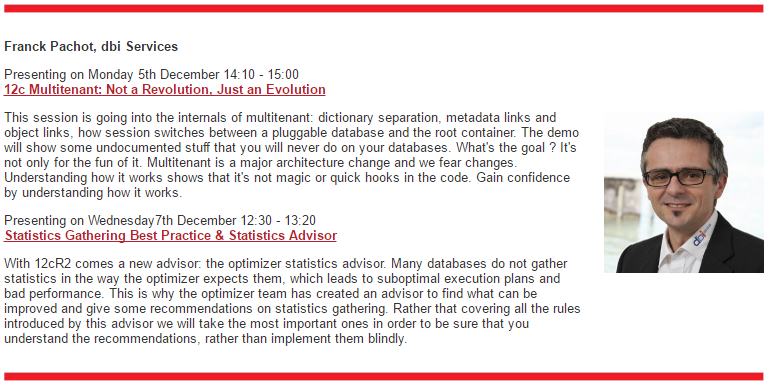
By Franck Pachot . Today at UKOUG TECH16 conference I’m presenting the internals of the new multitenant architecture: 12c Multitenant: Not a Revolution, Just an Evolution. My goal is to show how it works, that metadata links and object links are not blind magic. Here are the links to the blog posts I’ve published about multitenant internals. The dictionary separation,… 

Encryption in Oracle Public Cloud

By Franck Pachot . Oracle Transparent Data Encryption is available without option on the Oracle Public Cloud: Standard Edition as well as Enterprise Edition (EE, EE-HP EE-EP, ECS). More than that, the DBaaS enforces TDE for any user tablespace even when not specifying in the CREATE TABLESPACE. It you are not familiar with TDE key management (wallets) then you have… 

Oracle 12c – Finding the DBID – The last resort

By William Sescu The DBID is a very important part for Oracle databases. It is an internal, uniquely generated number that differentiates databases. Oracle creates this number automatically as soon as you create the database. During normal operation, it is quite easy to find your DBID. Whenever you start your RMAN session, it displays the DBID. oracle@oel001:/home/oracle/ [OCM121] rman target… 

12cR2: Upgrade by remote clone with TDE in DBaaS

By Franck Pachot . Upgrading from 12.1 to 12.2 is easy in Oracle Public Cloud DBaaS because you are in multitenant. Here is how to clone a 12.1 PDB to 12.2 service. I’ve a service HP121 in 12.1.0.2 with one pluggable database PDB1 and a service HP122 in 12.2.0.1 with an empty CDB (only CDB$ROOT and PDB$SEED containers). Export TDE… 

12cR2: Upgrade by remote clone – workaround ORA-17630 in DBaaS

By Franck Pachot . Easier than unplug/plug, you can move pluggable databases with remote cloning. It’s the same idea but you don’t have to manage the files yourself: the are shipped through database link. However, this uses the ‘remote file protocol’ and it fails with version mismatch: ORA-17628: Oracle error 17630 returned by remote Oracle server ORA-17630: Mismatch in the… 

12cR2: How long to upgrade a PDB?

By Franck Pachot . In the previous post I described how simple it is to unplug a PDB and plug it into a newer version CDB. One goal of dictionary separation in the multitenant architecture is to keep system objects on CDB$ROOT only. Knowing that an upgrade does not touch the application metadata and data, does this make PDB upgrade… 

12cR2: Upgrade by unplug/plug in the Oracle Cloud Service

By Franck Pachot . 12.2 is available in the Oracle Public Cloud DBaaS. If you have a 12.1 DBaaS service, there’s no button to upgrade it. I’ll describe all the possible upgrade procedures and the first one, and the most simple, is to create a new DBaaS service in 12.2 and unplug/plug the PDBs to it. Here is my DBaaS… 

12cR2: CREATE_FILE_DEST for PDB isolation

By Franck Pachot . Two years ago I filled an OTN idea to ‘Constrain PDB datafiles into specific directory’ and made it an enhancement request for 12c Release 2. When you provision a PDB, the PDB admin can create tablespaces and put datafiles anywhere in your system. Of course this is not acceptable in a cloud environment. 12.1 has a…