
SQL Server 2025 In-Memory: New Cleanup Features & SQLBits 2026 Insights
SQL Server 2025 finally allows dropping In-Memory filegroups, a breakthrough analyzed here alongside expert performance insights from SQLBits 2026.

SQL Server 2025 finally allows dropping In-Memory filegroups, a breakthrough analyzed here alongside expert performance insights from SQLBits 2026.

By Franck Pachot . For a previous post I’ve run on 18c a script of mine to get the V$MYSTAT delta values between two queries. This script (new version available on GitHub) generates the queries to store some values and subtract them on the next execution. But I had to fix it for 18c because I relied on some order…

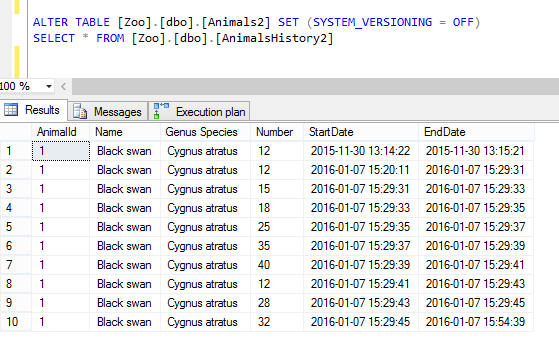
In SQL Server 2016 CTP 3.0, temporal tables with In-Memory OLTP is supported. 🙂 At the JSS2015 (Journée SQL Server 2015), I have presented a little demo about temporal table with a table In-Memory. This article is a complement of my presentation and a good add to my series of Temporal Table. My first step is to create the temporal…
By Franck Pachot . By default, In-Memory Column Store population is done in background, asynchronously. There are two hidden parameters that can change this behavior, let’s see how it works. Note that this is only good for research, those parameters are undocumented which means that they may not behave as you think they would. In a demo about in-Memory (slides,video)…
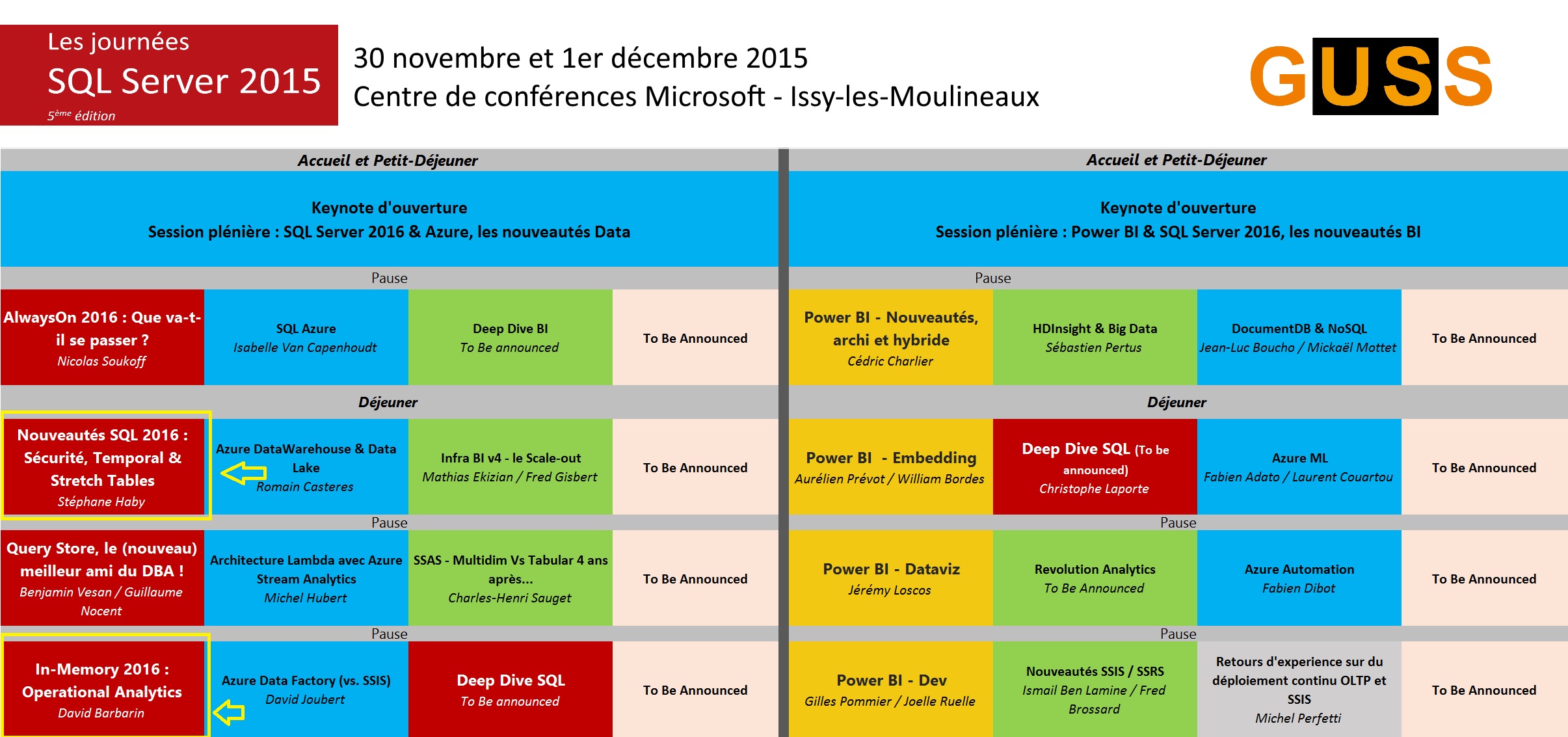
Faisant suite à la première annonce de David Barbarin sur les journées SQL Server du 30 novembre et 1er décembre, j’ai le plaisirs de vous inviter à venir nous voir également à notre stand. Effectivement, comme l’année passée, nous sommes heureux d’être à nouveau sponsors GOLD de l’événement et seront placés comme le schéma ci-dessous vous le montre. N’hésitez pas…


Les journées SQL Server se dérouleront dans un mois à Paris dans les locaux de Microsoft. L’agenda n’a été qu’en parte dévoilé mais c’est avec plaisir que je peux dores et déjà vous annoncer que dbi services sera de la partie cette année encore en tant que speaker et sponsor de l’événement. Pour ma part j’aurai le plaisir de vous…
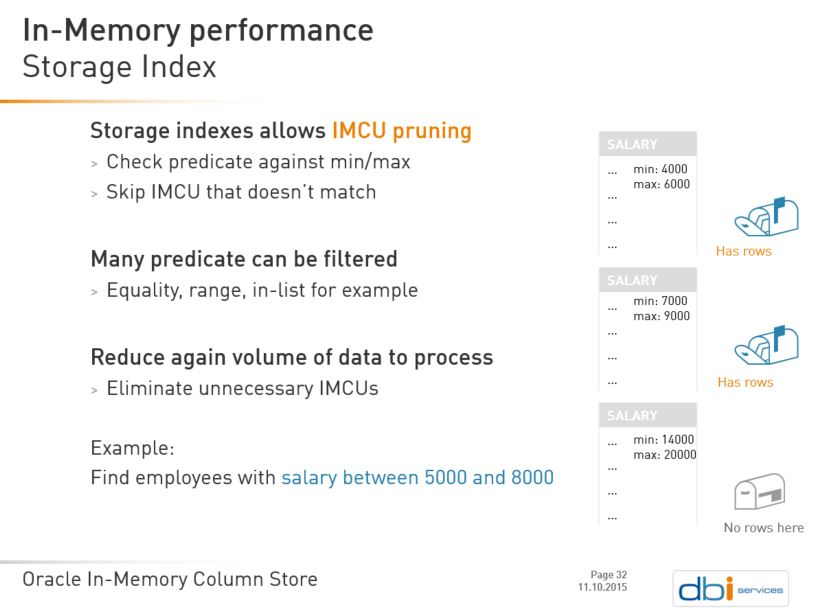
By Franck Pachot . In the previous post we have seen how In-Memory Compression Unit map to the physical persistent storage – table extents. Let’s see now how they are mapped to column values, allowing to optimize the scan in a similar way as Exadata Storage Indexes. The examples below will illustrate IMCU pruning and IMCU skip filtering. Here are…
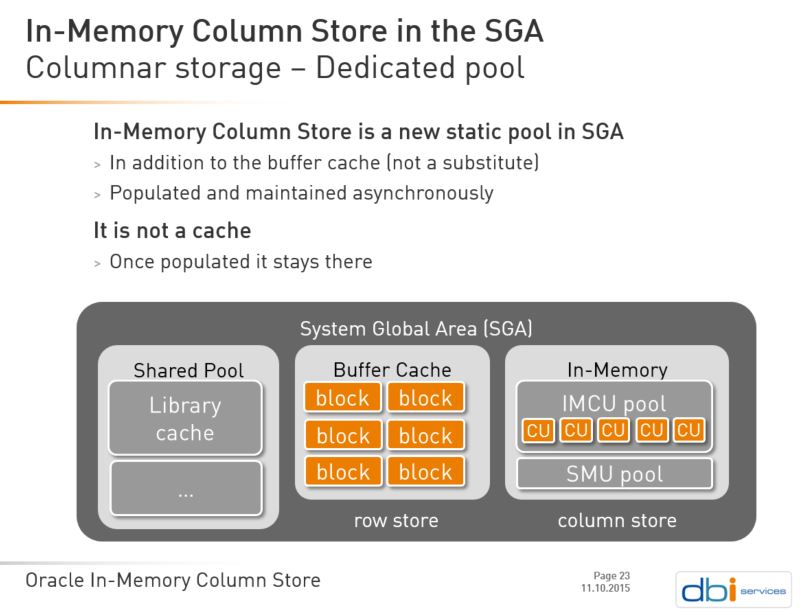
By Franck Pachot . Oracle In-Memory is an hybrid solution: an In-Memory Column Store in addition to the traditional Row Store. In the IMCS, data is stored in IMCU (In-memory compression units) and metadata is in SMU (Snapshot Metadata Units) In the row store, data is stored in datafile extents and metadata is stored in the dictionary (and in datafile…
By Franck Pachot . In the ‘traditional’ row store, the indexes are maintained at the same time as rows are changed. It’s different with the In-memory Column Store. Changes are maintained by background processes. When rows are changed, the Snapshot Metadata Units (SMU) logs the changes and In-Memory Compression Units (IMCU) are re-populated asynchronously. Let’s see an example. test case…
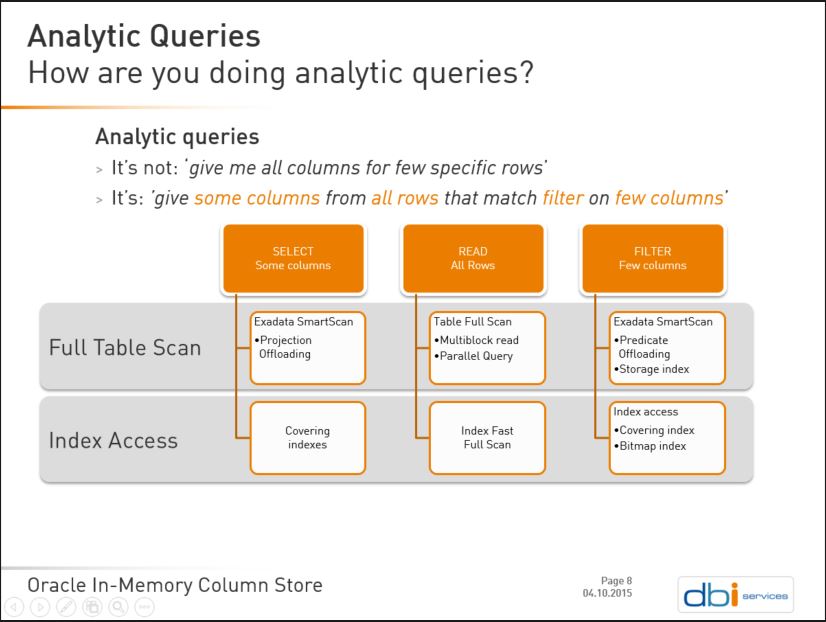
By Franck Pachot . Next Tuesday in Geneva I’m presenting Oracle In-Memory Column Store to Business Intelligence people at the Swiss BI Day After defining what is an analytic query, I show the different approaches to optimize that in Oracle, IMCS being the latest one. Here are some details about that slide. What is an analytic query? First definition –…

In SAP HANA, you have two possibilities to create the Calculated Views: Using the graphical method Using the scripting method with CE functions In this blog, I will demonstrate that CE Functions can improve performances from a Calculated View. First, I will give you some general information regarding the CE Functions. After that, I will show you the two different…


Everybody is talking about in-memory databases these days. And everybody is talking about columnar store for sets of data because this can be a benefit for analytic queries. And a lot of people start mixing these terms not realizing that these topics are not exchangeable. Traditionally in-memory means: Not persistent, but fast. And this is what pure in-memory databases are:…