Skip to content

Data Guard

DataGuard and Transparent Data Encryption

By Mouhamadou Diaw Setting up a DatagGard environment for a database with Transparent Data Encryption requires some tasks concerning the encryption keys. Otherwise the steps are the same than for an environment without TDE. In this blog we will present the tasks we have to do on both primary and standby servers for the keys. We will not describe the… 

Automatic Block Media Recovery in a DataGuard

By Mouhamadou Diaw With Oracle 12.2, in a Data Guard environment corrupted data blocks can be automatically replaced with uncorrupted copies of those blocks. There are just some requirements: • The physical standby database must be operating in real-time query mode, which requires an Oracle Active Data Guard license. • The physical standby database must be running real-time apply. Automatic… 

18c new Lost Write Protection

By Franck Pachot . There are many layers between the Oracle Database pwrite() calls and the physical sector written on disk: filesystem, logical volume, SAN or NAS, with a lot of smart software running for Virtualisation, Compression, Snapshotting, Synchronisation… Are you sure that the changes you made to your data is actually persisted on disk, completely and without any corruption?… 

18c, Cloud First and Cloud Only features: think differently

By Franck Pachot . Remember the times when the Oracle Software features were the same on all platforms? Where Oracle databases could be ported to any relevant platform? Where we were able to try any feature, freely, by downloading the latest release software? Now we need to think differently. Because: The new software is released on Cloud first The major… 

Server process name in Postgres and Oracle

By Franck Pachot . Every database analysis should start with system load analysis. If the host is in CPU starvation, then looking at other statistics can be pointless. With ‘top’ on Linux, or equivalent such as process explorer on Windows, you see the process (and threads). If the name of the process is meaningful, you already have a clue about… 

Multitenant, PDB, ‘save state’, services and standby databases

By Franck Pachot . Creating – and using – your own services has always been the recommendation. You can connect to a database without a service name, though the instance SID, but this is not what you should do. Each database registers its db_unique_name as a service, and you can use it to connect, but it is always better to… 

Keep your orapw password file secure

By Franck Pachot . This is a small demo I did when I’ve found a database password file (orapw) lying around in /tmp with -rw-rw-rw- permissions, to show how this is a bad idea. People think that the orapw file only contains hashes to validate a password given, and forget that it can be used to connect to a remote… 

Unstructured vs. structured

By Franck Pachot . The title of this blog post was: “Tracing DBMS_RCVMAN for reclaimable archivelogs” until I started to write the conclusion… In a previous post I mentioned that there’s a bug with archivelog deletion policy when you want to mention both the ‘BACKED UP … TIMES TO …’ and ‘APPLIED’ or ‘SHIPPED’ as conditions for archived logs to… 

Archivelog deletion policy on Data Guard configuration

By Franck Pachot . The deletion policy on a dataguard configuration should be: CONFIGURE ARCHIVELOG DELETION POLICY TO APPLIED ON ALL STANDBY; for the site where you don’t backup. It can be the standby or the primary. and: CONFIGURE ARCHIVELOG DELETION POLICY TO APPLIED ON ALL STANDBY BACKED UP 1 TIMES TO DISK; for the site where you do the… 

Autonomous Database

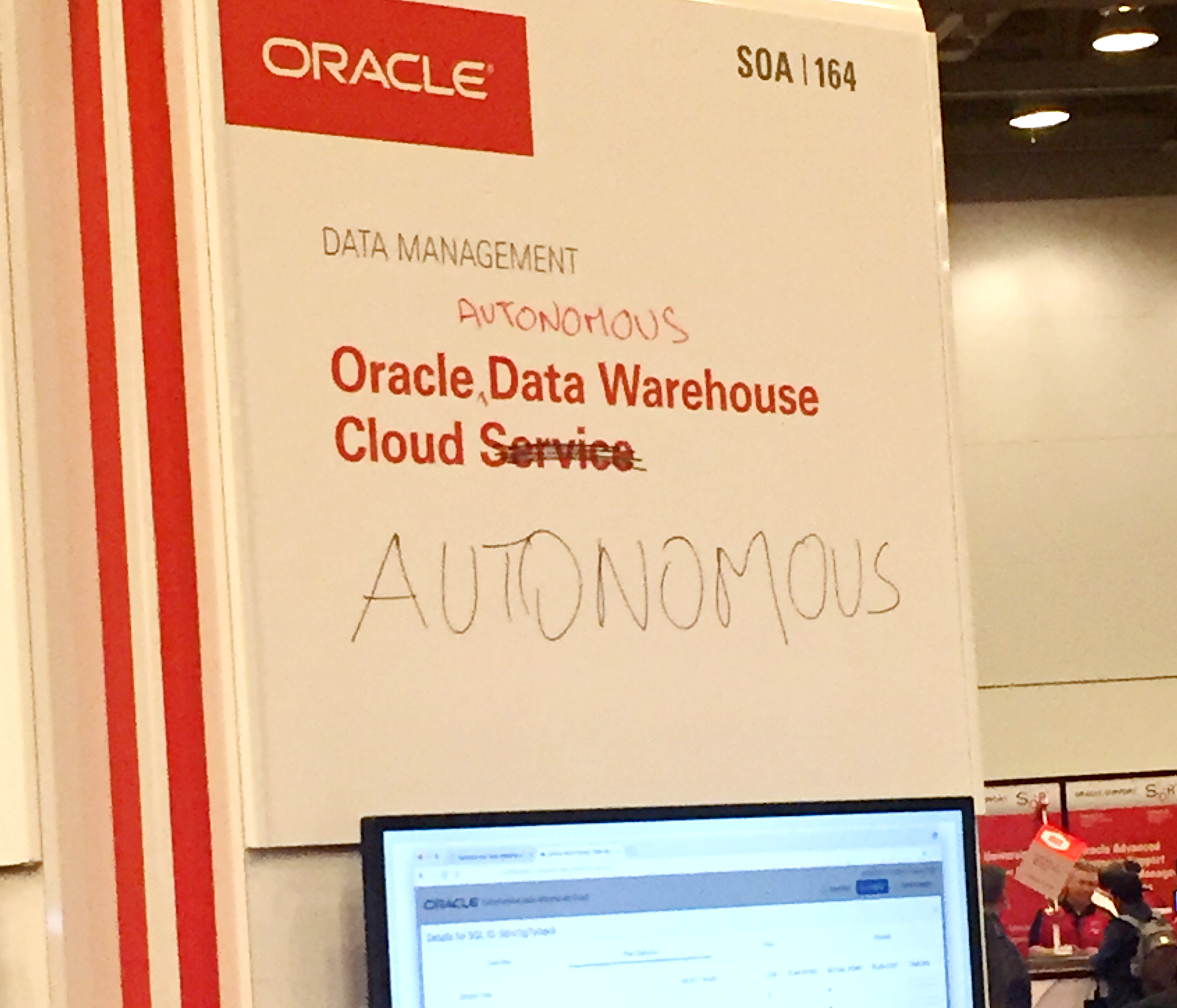
By Franck Pachot . Larry Ellison has announced Oracle 18c to be the Autonomous Database, the no-human labor, and self-driven, database. Here is a quick recap of what it is behind the marketing words. My opinion only. Autonomous Since Oracle decided to be a public cloud PaaS provider, they announced ‘unmanaged’ and ‘managed’ services. The managed service for DBaaS is…