When discussing modern application platforms, JBoss EAP is rarely the technology that creates the most excitement. Today, the attention is more often on Kubernetes, OpenShift, Quarkus, serverless platforms, service meshes, GitOps, and event-driven architectures.
In this context, the question is not simply: “Should we replace JBoss EAP?”
The real question is: “How can we modernize these workloads without creating unnecessary risk?”
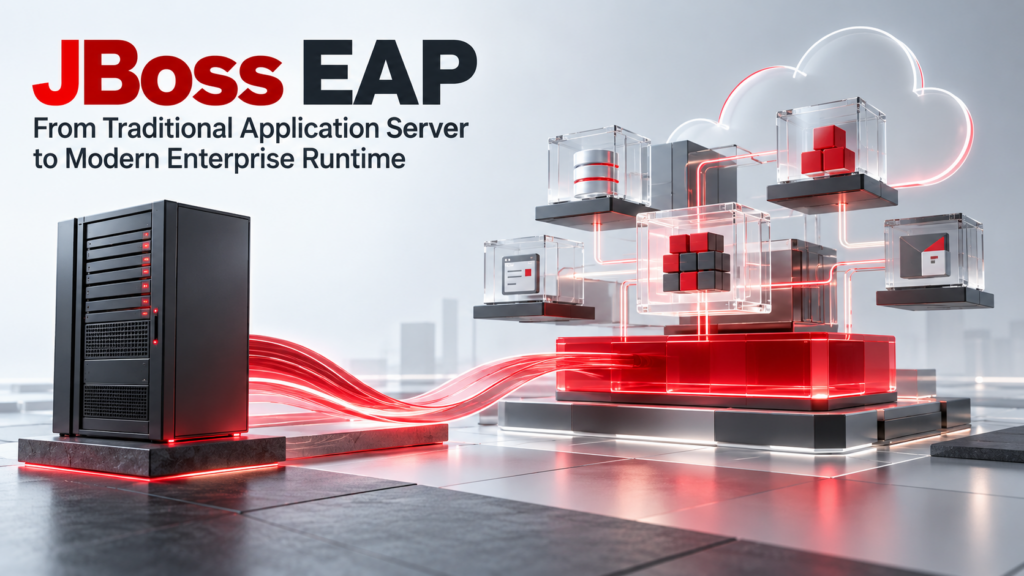
JBoss EAP still has a future, but its role is changing. It should no longer be seen only as a traditional application server running on long-living virtual machines. Its future is as a supported enterprise Java runtime that can help customers modernize progressively, especially when moving toward OpenShift.
But in large enterprise environments, technology relevance is not measured only by hype. It is measured by stability, supportability, lifecycle, risk, operational maturity, and the ability to run critical workloads for many years.
From that perspective, JBoss EAP still has a future!
Not because every new Java application should be deployed on a traditional application server. That would not be realistic. Its future is different: JBoss EAP remains a strategic runtime for enterprise Java systems that require continuity, long-term support, and controlled modernization.
The future of EAP is linked to application lifecycle, not hype
Many enterprise applications are not replaced every three years. They live for ten, fifteen, sometimes twenty years. They support billing, public administration, banking processes, insurance workflows, logistics, healthcare platforms, or internal business systems.
For these applications, the most important question is not whether the runtime is fashionable. The question is whether the platform remains supportable, secure, upgradeable, and aligned with the enterprise roadmap.
This is where JBoss EAP has value.
Its future will be driven by customers who need a stable enterprise Java platform for existing workloads, not by teams looking for the lightest runtime for a new microservice.
Red Hat’s direction: continuity with modernization
Red Hat’s strategy around JBoss EAP is not to freeze the platform in the past. The move to EAP 8 and Jakarta EE 10 shows that the product continues to follow the evolution of enterprise Java.
This is a major point. Jakarta EE 10 is not just a cosmetic version change. For many customers, it forces a real application review, especially because of the namespace migration from javax.* to jakarta.*, dependency updates, library compatibility, and testing effort.
That means the future of JBoss EAP is not passive. Customers will still need migration projects, compatibility assessments, application testing, dependency cleanup, and platform upgrades.
In parallel, Red Hat also positions EAP in the OpenShift ecosystem, with supported container images and deployment approaches for OpenShift. This confirms that EAP is not limited to the traditional VM model anymore.
The message is clear: JBoss EAP is evolving, but in an enterprise way. It does not try to become Quarkus. It keeps its role as a supported Jakarta EE application platform while becoming more compatible with modern operational models.
The real challenge: reducing dependency on the application server
Some applications depend too much on the application server. Over the years, many systems have accumulated runtime-specific assumptions:
- server-specific modules,
- configuration hidden in the application server,
- hardcoded JNDI names,
- deployment scripts known only by operations teams,
- local filesystem dependencies,
- legacy security mechanisms,
- clustering assumptions,
- old libraries bundled with the application.
These are not only technical details. They are modernization blockers.
A good EAP strategy should therefore not only be “upgrade the server.” It should also reduce unnecessary coupling between the application and the runtime.
The objective is not to leave EAP. The objective is to make the application more portable, more testable, easier to deploy, and less dependent on hidden server configuration.
This is where consulting expertise brings value: identifying which dependencies are legitimate enterprise platform usage, and which ones are accidental complexity created by years of operations.
Conclusion
The future of JBoss EAP is not about competing with every modern Java runtime.
Its future is to remain a reliable enterprise platform for applications that still need the Jakarta EE model, long-term support, and controlled modernization.
At the same time, customers should not ignore Quarkus, Spring Boot, or other modern runtimes. But Quarkus does not replace JBoss EAP in all cases. The right strategy is not to force a single runtime everywhere. The right strategy is to understand the application lifecycle, reduce unnecessary runtime coupling, and choose the platform that matches the workload.
In the future, JBoss EAP will remain strategic wherever enterprise Java continuity, supportability, and risk control matter.
![Thumbnail [60x60]](https://www.dbi-services.com/blog/wp-content/uploads/2022/09/DDI_web-min-scaled.jpg)