Skip to content

Oracle

Oracle Database as our consultants live it every day: installation and patching, upgrades, RMAN backup and recovery, Data Guard, RAC, performance tuning, multitenant, licensing, and engineered systems such as ODA and Exadata.

DataGuard broker properties – Part II: log shipping parameters

By Franck Pachot . In the part I we have seen the properties that are imported when you add a database to the configuration, and which are then managed by the broker. Now we will list the properties that are managed by the broker, but whose default value is not imported from the instance parameters. LogXpt properties Here are the… 
OCM 12c preparation: Materialized View explain_rewrite

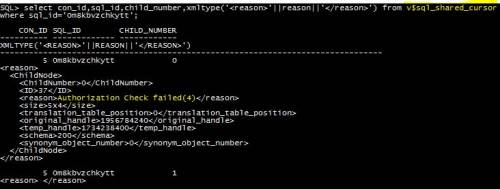
By Franck Pachot . When I passed the OCM 11g exam, I had to prepare the ‘Manage Materialized Views to improve rewrite’ topic. Now that I’m preparing the 12c upgrade I checked quickly what I’ve prepared… and it doesn’t work. This post is about query rewrite, a bug in 12c, how to understand why it doesn’t rewrite, and how rewrite… 

DataGuard broker properties – Part I: imported parameters

By Franck Pachot . When you are using the DataGuard Broker, you should always use the broker (with DGMGRL or OEM) to change the parameters that are managed, rather than changing them with ALTER SYSTEM. But do you know which parameters are concerned? I’ve divided the parameters in two parts. All are set by the broker, but only some of… 

RESULT_CACHE hint expiration options

By Franck Pachot . The result cache is very nice when base tables are static: get the result without any buffer get, without any join or sorts. But as soon as any DML occurs on one of the tables the result is based on, then result cache is invalidated. And cache misses are quite expensive. You can think of it… 

Multitenant vs. schema based consolidation

By Franck Pachot . If you want to install multiple instances of a software, for example you host the ERP for several companies or subsidiaries, you have 3 solutions: have one database and multiple schema have multiple databases have one database and multiple pluggable databases Of course, this is exactly the reason for pluggable databases: multitenant. You have good isolation… 

Oracle Log Writer and Write-Ahead-Logging

By Franck Pachot . I posted a tweet with a link to a very old document – 20 years old – about ‘internals of recovery’. It’s a gem. All the complexity of the ACID mecanisms of Oracle are explained in a very simple way. It was written for Oracle 7.2 but it’s incredible to see how much the basic things… 

Oracle Database Cloud Service – My first trial

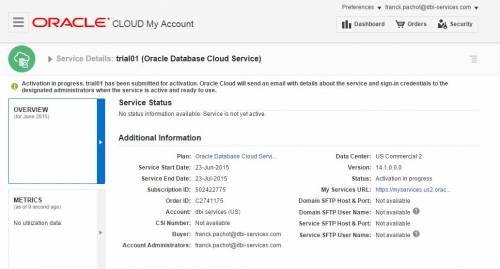
By Franck Pachot . The cloud has been annouced, I want to try. From the cloud.oracle.com/database website, there is Trial only for the ‘Database Schema Service’ so I asked fot it, received an e-mail with connection info and it works:   Good. The password was temporary, so I have to change it, and set answers to 3 within 4 questions… 

RAC buffer states: XCUR, SCUR, PI, CI

By Franck Pachot . In RAC, blocks are copied across instances by the Global Cache Service. In single instance, we have only two status: CR for consistent read clones where undo is applied, and CUR for the current version that can be modified (then being a dirty block). I’ts a bit more complex in RAC. Here is a brief example… 

Multithreaded 12c and ‘connect / as sysdba’

By Franck Pachot . In Oracle 12c you can run Oracle processes as operating system threads, lowering the number of OS processes. But you can’t use OS authentification: you need to provide a password. Here is a way to set an environment so that you can still ‘connect / as sysdba’ to a multithreaded instance. Windows I start with Windows… 

2 ways to move archivelogs – both need RMAN

By Franck Pachot . The database must know where are the files. If you move them from the OS, the database will not be aware of it. But there is a database tool to copy or move files and update the database repository (controlfile). It’s RMAN. With RMAN you can either: update the repository after you’ve moved the file from… 

Buffer pool advisory in AWR

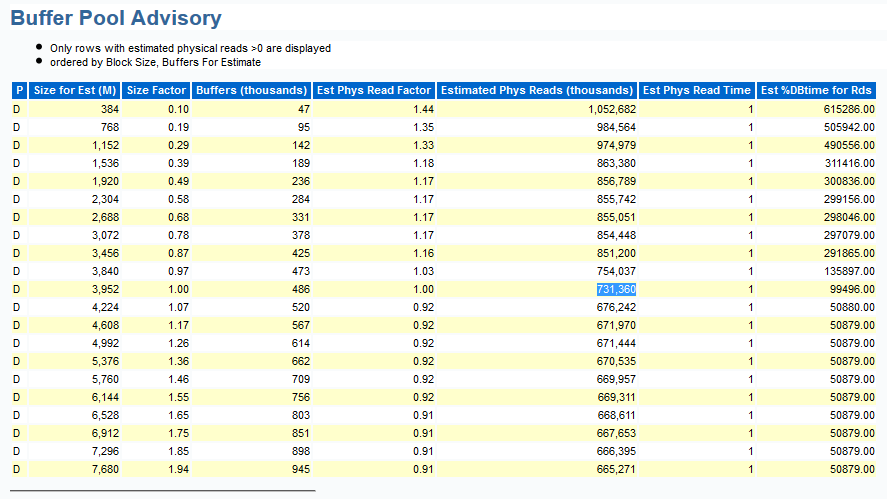
By Franck Pachot . In Oracle memory advisors: how relevant ? I said that advisors are calculating their recommendations from statistics cumulated since the begining of the instance, even in AWR which is supposed to cover only a short period. Here is a quick test on buffer pool advisory to validate that assumption. I’m running the following query to compare… 

Does the block size matter?

By Franck Pachot . The default block size is 8k in Oracle. This is the most common. Sometimes, people create the database with 16k block size for datawarehouses. You can also find some 32k block size, but less common which means more bugs. In our tuning workshop we recommend the default, 8k, for most of the cases. I’ll show here…