Skip to content

Middleware Team

Posts published under the Middleware Team account are collective contributions by the dbi services middleware and enterprise content management consultants. The practice covers ECM platforms such as OpenText Documentum, Alfresco, and M-Files, as well as application servers and integration technologies including WebLogic, JBoss, Tomcat, and the Elastic Stack, from architecture and deployment to operations under service level agreements.

322 posts since February 2013

Documentum upgrade project: ADTS local user or domain user?

ADTS local user or domain user: Which user should I choose as the installation owner? This question is important if you are installing a new Advanced Document Transformation Services (ADTS).  You can opt for a domain user in order to have one user for several ADTS installations with less AD management. Or you may want to opt for local users… 
Java get Class names from package String in classpath

As a Java developer you probably used to know about reflexion. However, in order to keep your software architecture flexible, some functionalities are sometimes not provided out of the box by the JVM. In my particular case, I needed to find out every Class and Sub-Classes inside a package, thus reparteed within several Jars. Internet has lots of solution, but… 

Documentum: some useful queries (DQL/IAPI)

In this blog post I want to sharing some useful DQL and IAPI queries that I am using all the time. They are more dedicated to Documentum support/debug and grouped by components. In order to use them, I recommend Qdman: it is the best tool I know to use DQL and IAPI scripts. 1. xPlore It regroups both the search… 

Java Mission Control 5.2 (7u40) deserves your attention

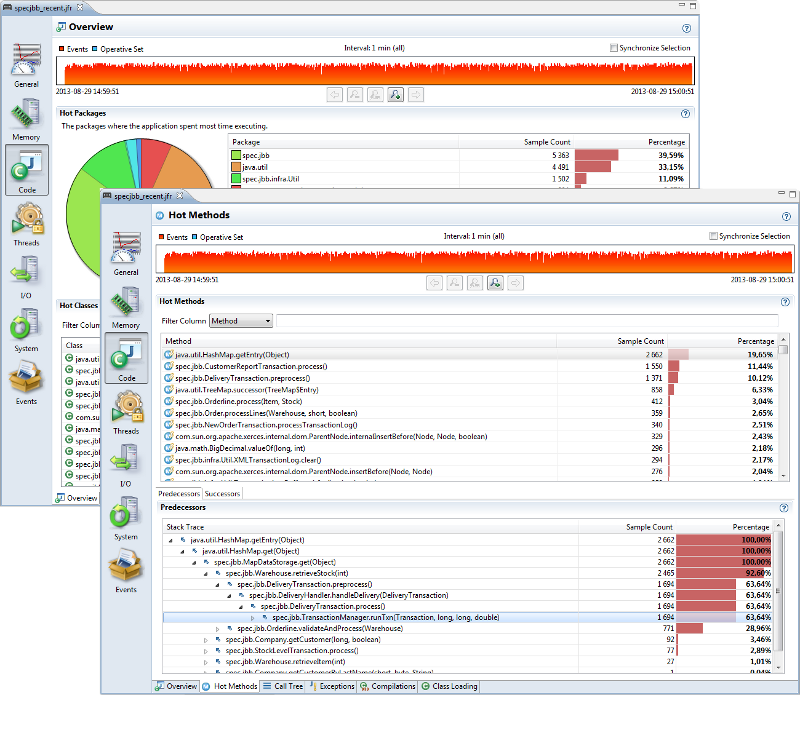
Recently, some new versions of java were made available. Most people think Java updates are boring and only security-oriented. But one of the last updates (7u40) includes a feature which deserves attention. I mean Java Mission Control 5.2. Hotspot incoming If you know the Oracle JRockit JVM a little bit, you might have heard about JMC, which was called JRockit… 

Understanding JVM Java memory leaks

Lots of people think that Java is free of memory management as the JVM uses a Garbage Collector. The goal of this collector is to free objects that are no longer used in the program without the developer being forced to declare that the object can be collected. Everything is automatic. It’s really helpful and it avoids wasting time in… 

Oracle Java EE 7 – an overview

After announcing the availability of Oracle Java Enterprise Edition 7 (Java EE 7 or JEE7), Oracle organized a web event for the launch, covering topics such as the new features and the java community as well as showing some examples of the new APIs. This blog post summarizes some key points of this event. The show was driven by the… 

A comparison of Java Virtual Machines: Hotspot JVM vs JRockit JVM

You might know that there are many JVMs available today, but do you know the difference between them? In this blog I will not state all JVMs as it will take too much time 🙂 But I will talk about Hotspot and JRockit, because they are pretty used and because they will eventually merge in Java 8! That’s what they… 

OpenERP release 7.0: Not just an update

OpenERP release 7.0, which just came out, shows some real advantages in terms of accessibility. By refining the website, OpenERP wants to prove that the new release is not merely an update but a new product with a new mind-set. The new features Indeed, the ERP’s web interface is now purified and simplified to match the fashions. Today’s user interfaces… 

Boot sequence for all Linux-based operating systems

In this bog posting, I will present a boot sequence that works for all Linux-based operating systems – from switching on the power to the login screen.   7 steps There are 7 steps for Linux startup: Power on Obviously, first of all, you have to switch on your computer, then: Each sub process will execute the following one It… 

Ceylon: a new language inspired from Java

On 26 February I went to the University of Bern with my colleague Arnaud Berbier to follow an introductory conference on Ceylon, a new language inspired from Java. Unfortunately not presented by Gavin King, the leading developer of Ceylon at Red Hat, the project still was well introduced by Stéphane Epardaud. He is a long-time open source user and contributor,…